UNITED STATES
SECURITIES AND EXCHANGE COMMISSION
Washington, DC 20549
________________________________________
SCHEDULE 14A
________________________________________
Proxy Statement Pursuant to Section 14(a) of the
Securities Exchange Act of 1934
(Amendment No. )
|
Filed by the Registrant |
☒ |
|
|
Filed by a Party other than the Registrant |
☐ |
Check the appropriate box:
|
☒ |
Preliminary Proxy Statement |
|
|
☐ |
Confidential, for Use of the Commission Only (as permitted by Rule 14a-6(e)(2)) |
|
|
☐ |
Definitive Proxy Statement |
|
|
☐ |
Definitive Additional Materials |
|
|
☐ |
Soliciting Material Pursuant to § 240.14a-12 |
ALLIED GAMING & ENTERTAINMENT, INC.
(Name of Registrant as Specified In Its Charter)
_________________________________________________________________
(Name of Person(s) Filing Proxy Statement if Other Than the Registrant)
Payment of Filing Fee (Check all boxes that apply)
|
☒ |
No fee required. |
|
|
☐ |
Fee paid previously with preliminary materials. |
|
|
☐ |
Fee computed on table in exhibit required by Item 25(b) per Exchange Act Rules 14a-6(i)(1) and 0-11. |
PRELIMINARY PROXY STATEMENT
SUBJECT TO COMPLETION DATED MAY 11, 2026
ALLIED GAMING & ENTERTAINMENT, INC.
745 Fifth Avenue, Suite 500
New York, New York 10151
NOTICE OF SPECIAL MEETING OF STOCKHOLDERS
To Be Held On , 2026
Dear Stockholders of Allied Gaming & Entertainment, Inc.:
You are cordially invited to virtually attend a special meeting of the stockholders (the “Special Meeting”) of Allied Gaming & Entertainment, Inc., a Delaware corporation (“Allied,” “we,” “us,” “our,” or the “Company”). The meeting will be held on , 2026 at 10 a.m. Eastern Time. To facilitate stockholder participation and save costs, the Special Meeting will be held in a virtual meeting format only at . The meeting will be held for the following purpose:
1. To approve an amendment to our Amended and Restated Certificate of Incorporation, as amended (“Certificate of Incorporation”), to effect a reverse stock split of our Common Stock, at a ratio in the range of 1-for-2 to 1-for-25, with such ratio to be determined in the discretion of our board of directors and with such reverse stock split to be effected at such time and date, if at all, as determined by our board of directors in its sole discretion (“Proposal 1” or the “Reverse Stock Split Proposal”).
This item of business is more fully described in the proxy statement (the “Proxy Statement”) accompanying this notice (“Notice”).
In addition to the foregoing, the Special Meeting will include the transaction of any other business relating to the purpose or purposes stated in this Notice and the accompanying Proxy Statement that may be properly brought before the meeting or any continuation, adjournment or postponement thereof.
The record date for the Special Meeting is , 2026. Only stockholders of record at the close of business on that date may vote on the proposal being presented at the Special Meeting or any adjournment, postponement, rescheduling, or continuation thereof.
Important Notice Regarding the Availability of Proxy Materials for the Special Meeting to Be Held Virtually on , 2026 at 10 a.m. Eastern Time at .
The Proxy Statement is available at www.proxyvote.com.
By Order of the Board of Directors,
Yangyang Li
Chief Executive Officer
May , 2026
Whether or not you expect to attend the virtual meeting, please complete, date, sign and return the enclosed proxy, or vote over the telephone or the Internet as instructed in these materials, as promptly as possible in order to ensure your representation at the meeting. Even if you have voted by proxy, you may still vote if you attend the virtual meeting. Please note, however, that if your shares are held of record by a broker, bank or other nominee and you wish to vote at the virtual meeting, you must obtain a proxy issued in your name from that record holder.
i
PRELIMINARY PROXY STATEMENT — SUBJECT TO COMPLETION
ALLIED GAMING & ENTERTAINMENT, INC.
745 Fifth Avenue, Suite 500
New York, New York 10151
PROXY STATEMENT
FOR THE SPECIAL MEETING OF STOCKHOLDERS
To be held on , 2026
QUESTIONS AND ANSWERS ABOUT THESE PROXY MATERIALS AND VOTING
When is this Proxy Statement and accompanying proxy card (“Proxy Card”) first being mailed to stockholders?
This Proxy Statement and Proxy Card are first being mailed on or about May , 2026 to stockholders of record entitled to vote at the Special Meeting.
How do I attend the Special Meeting?
In order to facilitate stockholder participation and save costs, the meeting will be held virtually on , 2026 at 10 a.m. Eastern Time. There will not be a physical meeting. We have worked to offer the same participation opportunities as if you attended the Special Meeting in person and hope the online format will allow more stockholders to participate by removing any barriers caused by travel requirements. You may attend the Special Meeting online, including voting and submitting questions, at by entering the 16-digit control number included on your Proxy Card. You should ensure you have a strong Internet connection wherever you intend to participate in the Special Meeting. We encourage you to access the Special Meeting before it begins. Online check-in will begin at 9:30 a.m. Eastern Time on the date of the Special Meeting.
Our virtual meeting provider facilitates stockholders’ opportunity to ask questions during the meeting. The Special Meeting site will provide stockholders with information regarding (i) time guidelines for their questions, rules around what types of questions are allowed, and rules for how questions and comments will be recognized and disclosed to meeting participants; and (ii) procedures for posting appropriate questions received during the meeting. Once you are logged into the Special Meeting, you will be able to submit your questions directly to the Company. Our virtual meeting will be governed by our rules of conduct and procedures, which will be posted at in advance of the Special Meeting.
You may obtain instructions for how to access the Special Meeting online at . If you encounter any difficulties accessing the virtual meeting during the check-in or meeting time or need support in addressing technical and logistical issues related to accessing the virtual meeting platform, a technical assistance phone number will be made available on the virtual meeting registration page at , 30 minutes prior to the start of the meeting.
Who can vote at the Special Meeting?
Only stockholders of record at the close of business on , 2026 (the “Record Date”) will be entitled to vote on the proposal being presented at the Special Meeting. On the Record Date, there were shares of common stock of the Company outstanding and entitled to vote.
Stockholder of Record: Shares Registered in Your Name
If on , 2026, your shares were registered directly in your name with the Company’s transfer agent, Continental Stock Transfer & Trust Company, then you are a stockholder of record. As a stockholder of record, you may vote by virtually attending the Special Meeting and voting during the Special Meeting or vote over the telephone or the Internet or by proxy card. Whether or not you plan to virtually attend the Special Meeting, we urge you to vote by proxy to ensure your vote is counted.
1
Beneficial Owner: Shares Registered in the Name of a Broker or Other Nominee
If on , 2026, your shares were held, not in your name, but rather in an account at a brokerage firm, bank, dealer, other similar organization, or other nominee, then you are the beneficial owner of shares held in “street name” and these proxy materials are being forwarded to you by that organization. The organization holding your account is considered to be the stockholder of record for purposes of voting on the proposal being presented at the Special Meeting. As a beneficial owner, you have the right to direct your broker or other agent regarding how to vote the shares in your account. You are also invited to virtually attend the Special Meeting.
What am I voting on?
There is one matter scheduled for a vote:
• Proposal 1: To approve an amendment to our Amended and Restated Certificate of Incorporation, as amended (“Certificate of Incorporation”), to effect a reverse stock split of our Common Stock, at a ratio in the range of 1-for-2 to 1-for-25, with such ratio to be determined in the discretion of our board of directors and with such reverse stock split to be effected at such time and date, if at all, as determined by our board of directors in its sole discretion (“Proposal 1” or the “Reverse Stock Split Proposal”).
How does the Board recommend that I vote on the proposal?
The Board recommends that you vote “FOR” Proposal 1: the Reverse Stock Split Proposal.
What if another matter is properly brought before the meeting?
The Board knows of no other matters that will be presented for consideration at the Special Meeting. If any other matters are properly brought before the meeting, it is the intention of the persons named in the accompanying Proxy Card to vote on those matters in accordance with their best judgment, subject to compliance with Rule 14a-4(c) of the Securities Exchange Act of 1934, as amended (the “Exchange Act”).
How do I vote?
All shares represented by valid proxies that we receive through this solicitation, and that are not revoked, will be voted in accordance with your instructions on the Proxy Card or as instructed via the Internet or telephone. You may specify whether your shares should be voted for, against, or abstain with respect to the proposal. Voting by proxy will not affect your right to attend the Special Meeting.
The procedures for voting are as follows:
Stockholder of Record: Shares Registered in Your Name
If you are a stockholder of record, you may vote by virtually attending the Special Meeting and voting during the Special Meeting, vote by proxy over the telephone, vote by proxy through the Internet or vote by proxy using a Proxy Card. Whether or not you plan to virtually attend the Special Meeting, we urge you to vote by proxy to ensure your vote is counted. You may still virtually attend the Special Meeting and vote during the Special Meeting even if you have already voted by proxy.
To vote using the Proxy Card, simply complete, sign and date the Proxy Card and return it promptly in the envelope provided. If you return your signed Proxy Card to us before the Special Meeting, we will vote your shares as you direct.
• To vote over the telephone, dial toll-free using a touch-tone phone and follow the recorded instructions. You will be asked to provide the company number and 16-digit control number included on your Proxy Card. Your telephone vote must be received by 11:59 p.m. Eastern Time on May , 2026 to be counted.
• To vote through the Internet, go to to complete an electronic proxy card. You will be asked to provide the company number and 16-digit control number from your Proxy Card. Your Internet vote must be received by 11:59 p.m. Eastern Time on May , 2026 to be counted.
2
• If you virtually attend the Special Meeting, you can also vote during the Special Meeting by visiting and entering the 16-digit control number included on your Proxy Card (if you received a printed copy of the proxy materials).
Beneficial Owner: Shares Registered in the Name of Broker or Bank
If you are a beneficial owner of shares registered in the name of your broker, bank, or other nominee, you should have received voting instructions from that organization rather than from us. Simply follow the instructions in the voting instruction form to ensure that your vote is counted.
How many votes do I have?
On each matter to be voted upon, you have one vote for each share of common stock of the Company you own as of , 2026.
What happens if I do not vote?
Stockholder of Record: Shares Registered in Your Name
If you are a stockholder of record and do not vote by completing your Proxy Card, or by telephone, through the Internet, or by virtually attending the Special Meeting and voting during the Special Meeting, your shares will not be voted.
Beneficial Owner: Shares Registered in the Name of Broker or Other Nominee
If you are a beneficial owner whose shares of record are held by a broker, you may instruct your broker how to vote your shares. If you do not give instructions to your broker, the broker will determine if it has the discretionary authority to vote on the particular matter. Under NYSE rules, which are also applicable to Nasdaq-listed companies, brokers, banks and other securities intermediaries that are subject to NYSE rules may use their discretion to vote your “uninstructed” shares on matters considered to be “routine” under NYSE rules but not with respect to “non-routine” matters. Due to the timing of this proxy mailing, which is less than 15 days before the Special Meeting, brokers do not have discretionary authority to vote on Proposal 1 without your instructions. Therefore, it is important that you provide your voting instructions to your broker to ensure your vote is counted.
What if I return a Proxy Card or otherwise vote but do not make specific choices?
If you voted by proxy without marking any voting selections, then the proxy holders will vote your shares as recommended by the Board on all matters presented in this Proxy Statement, and as the proxy holders may determine in their discretion with respect to any other matters properly presented for a vote at the Special Meeting.
Who is paying for this proxy solicitation?
We will pay for the entire cost of soliciting proxies. We may also reimburse brokerage firms, banks and other agents for the cost of forwarding proxy materials to beneficial owners.
What does it mean if I receive more than one Proxy Statement and Proxy Card?
If you receive more than one Proxy Statement and Proxy Card, your shares may be registered in more than one name or in different brokerage accounts. Please follow the voting instructions on the Proxy Card to ensure that all of your shares are voted. Remember, you may vote by telephone, Internet or by signing, dating and returning a Proxy Card, or by voting at the Special Meeting.
3
Can I change my vote or revoke my proxy?
Stockholder of Record: Shares Registered in Your Name
Yes. You may change your vote or revoke your proxy at any time before the final vote at the Special Meeting. If you are the record holder of your shares, you may change your vote or revoke your proxy in any one of the following ways:
• You may submit a properly completed Proxy Card with a later date.
• You may grant a subsequent proxy by telephone or through the Internet.
• You may send a timely written notice that you are revoking your proxy to our Corporate Secretary at our principal executive offices at 745 Fifth Avenue, Suite 500, New York, NY 10151.
• You may virtually attend the Special Meeting and vote online during the Special Meeting. Simply virtually attending the Special Meeting will not, by itself, revoke your proxy. You must specifically request at the Special Meeting that it be revoked.
Beneficial Owner: Shares Registered in the Name of Broker or Bank
If your shares are held by your broker or bank as a nominee or agent, you should follow the instructions provided by your broker or bank.
Your most current vote that is valid, whether by telephone, Internet or proxy card is the one that will be counted.
What are “broker non-votes”?
If you are a beneficial owner whose shares of record are held by a broker, you may instruct your broker how to vote your shares. If you do not give instructions to your broker, the broker will determine if it has the discretionary authority to vote on the particular matter. Under NYSE rules, which are also applicable to Nasdaq-listed companies, brokers, banks and other securities intermediaries that are subject to NYSE rules may use their discretion to vote your “uninstructed” shares on matters considered to be “routine” under NYSE rules but not with respect to “non-routine” matters.
A broker non-vote occurs when a broker, bank or other agent has not received voting instructions from the beneficial owner of the shares and the broker, bank or other agent cannot vote the shares. Broker non-votes, if any, will be counted for purposes of calculating whether a quorum is present at the meeting, but will not be counted for purposes of determining the number of votes cast with respect to a particular proposal.
Due to the timing of this proxy mailing, which is less than 15 days before the Special Meeting, brokers do not have discretionary authority to vote on Proposal 1 without your instructions. Therefore, it is important that you provide your voting instructions to your broker to ensure your vote is counted.
How many votes are needed to approve the proposal?
To be approved, Proposal 1 requires the affirmative vote of a majority of the votes cast by the holders of all of the shares of Common Stock present virtually or represented by proxy at the Special Meeting. Abstentions and broker non-votes, if any, will have no effect on the results of the vote.
What is the quorum requirement and how will votes be counted?
A quorum of stockholders is necessary to hold a valid meeting. A quorum will be present if stockholders holding at least one-third of the issued and outstanding shares of common stock entitled to vote at the Special Meeting are deemed present at the Special Meeting, virtually or represented by proxy. On the record date, there were shares outstanding and entitled to vote. Thus, the holders of shares must be deemed present virtually or represented by proxy at the Special Meeting to have a quorum.
4
Your shares will be counted towards the quorum only if you submit a valid proxy (or one is submitted on your behalf by your broker, bank or other nominee) or if you vote electronically at the Special Meeting. Abstentions and broker non-votes, if any, will be counted towards the quorum requirement.
How can I find out the results of the voting at the Special Meeting?
Voting results will be published in a Current Report on Form 8-K that we expect to file within four business days after the Special Meeting. If final voting results are not available to us in time to file a Current Report on Form 8-K within four business days after the Special Meeting, we intend to file a Current Report on Form 8-K to publish preliminary results and, within four business days after the final results are known to us, file an additional Current Report on Form 8-K to publish the final results.
What proxy materials are available on the Internet?
The Proxy Statement and Proxy Card are available at .
If you have any questions or need assistance in voting your shares, please contact us:
Allied Gaming & Entertainment, Inc.
745 Fifth Avenue, Suite 500
New York, NY 10151
Telephone: (646) 768-4240
5
Proposal 1
Background
Our Board has approved a series of alternate amendments to our Certificate of Incorporation, which would effect a reverse stock split of all issued and outstanding shares of our Common Stock, at a ratio ranging from 1-for-2 to 1-for-25, inclusive (the “Reverse Stock Split”).
Accordingly, effecting the Reverse Stock Split would reduce the number of outstanding shares of our Common Stock. The effectiveness of any one of these amendments and the abandonment of the other amendments, or the abandonment of all of these amendments, will be determined by our Board following the Special Meeting. Our Board has recommended that these proposed amendments be presented to our stockholders for approval.
Our stockholders are being asked to approve these proposed amendments pursuant to Proposal 1, and to grant authorization to our Board to determine, at its option, whether to implement the Reverse Stock Split, including its specific timing and ratio.
Should we receive the required stockholder approval for Proposal 1, our Board will have the sole authority to elect, and without the need for any further action on the part of our stockholders, whether to effect the Reverse Stock Split and the number of whole shares of our Common Stock, between and including 2 and 25, that will be combined into one share of our Common Stock.
Notwithstanding approval of Proposal 1 by our stockholders, our Board may, at its sole option, abandon the proposed amendments and determine prior to the effectiveness of any filing with the Secretary of State of the State of Delaware not to effect any Reverse Stock Split, as permitted under Section 242(c) of the General Corporation Law of the State of Delaware.
By approving Proposal 1, our stockholders will: (a) approve a series of alternate amendments to our Certificate of Incorporation pursuant to which any whole number of outstanding shares of Common Stock between and including 2 and 25 could be combined into one share of Common Stock; and (b) authorize our Board to file only one such amendment, as determined by the Board at its sole option, and to abandon each amendment not selected by the Board. Our Board may also elect not to undertake any Reverse Stock Split and therefore abandon all amendments.
Approval of Reverse Stock Split of Our Common Stock
Our Board has adopted and is recommending that our stockholders approve a series of alternate amendments to our Certificate of Incorporation to effect the Reverse Stock Split. The text of the proposed form of Certificate of Amendment to our Certificate of Incorporation (the “Certificate of Amendment”) is attached hereto as Appendix A.
We are proposing that our Board have the discretion to select the Reverse Stock Split ratio from within a range between and including 1-for-2 and 1-for-25, rather than proposing that stockholders approve a specific ratio at this time, in order to give our Board the flexibility to implement the Reverse Stock Split at a ratio that reflects the Board’s then-current assessment of the factors described below under “Criteria to be Used for Determining Whether to Implement the Reverse Stock Split.” If the Board decides to implement the Reverse Stock Split, we will file the Certificate of Amendment with the Secretary of State of the State of Delaware and the Reverse Stock Split will be effective at 5:01 p.m., Eastern Time, on the date of filing of a Certificate of Amendment with the office of the Secretary of State of the State of Delaware, or such later date as is chosen by the Board and set forth in the Certificate of Amendment. Each of our stockholders will hold the same percentage of our outstanding Common Stock immediately following the Reverse Stock Split as such stockholder holds immediately prior to the Reverse Stock Split.
Reasons for Effecting the Reverse Stock Split
To maintain our listing on The Nasdaq Capital Market. By potentially increasing our stock price, the Reverse Stock Split would reduce the risk that our Common Stock could be delisted from The Nasdaq Capital Market. Our Common Stock is publicly traded and listed on Nasdaq under the symbol “AGAE.” To continue our listing on The
6
Nasdaq Capital Market, we must comply with Nasdaq Marketplace Rules, which requirements include Listing Rule 5550(a)(2) (the “Bid Price Requirement”). On November 4, 2025, we received a letter from Nasdaq notifying us that, for the last 30 consecutive business days, the bid price of our Common Stock had closed below $1.00 per share. In accordance with Listing Rule 5810(c)(3)(A), we were provided 180 calendar days, or until May 4, 2026, to regain compliance with the Bid Price Requirement. We have not regained compliance with the Bid Price Requirement and we are not eligible for another period of time to regain compliance with the Bid Price Requirement. In addition, we have not filed our Form 10-K for the period ended December 31, 2025, which Nasdaq noted as an additional basis for delisting the Company’s securities from The Nasdaq Stock Market.
The Board has considered the potential harm to us and our stockholders should Nasdaq delist our Common Stock from The Nasdaq Stock Market. Delisting would likely reduce the visibility, liquidity, and value of our Common Stock, reduce institutional investor interest in our company, and may increase the volatility of our Common Stock. Alternatives, such as the OTC Bulletin Board and the pink sheets, are generally considered to be less efficient markets. An investor likely would find it less convenient to sell, or to obtain accurate quotations in seeking to buy, our Common Stock on an over-the-counter market. Many investors likely would not buy or sell our Common Stock due to difficulty in accessing over-the-counter markets, policies preventing them from trading in securities not listed on a national exchange, transaction costs that represent a higher percentage of total share value than would be the case if our share price were higher or for other reasons. Delisting could also cause a loss of confidence of potential industry partners, lenders, and employees, which could further harm our business and our future prospects.
The Board believes that the proposed Reverse Stock Split is a potentially effective means for us to continue to maintain compliance with the Bid Price Requirement and to avoid, or at least mitigate, the likely adverse consequences of our Common Stock being delisted from The Nasdaq Capital Market by producing the immediate effect of increasing the bid price of our Common Stock.
To potentially improve the marketability and liquidity of our Common Stock. Our Board believes that the increased market price of our Common Stock expected as a result of implementing the Reverse Stock Split could improve the marketability and liquidity of our Common Stock and encourage interest and trading in our Common Stock.
• Stock Price Requirements: We understand that many brokerage houses, institutional investors and funds have internal policies and practices that either prohibit them from investing in low-priced stocks or tend to discourage individual brokers from recommending low-priced stocks to their customers or by restricting or limiting the ability to purchase such stocks on margin. Additionally, the Reverse Stock Split could help increase analyst and broker interest in our Common Stock as their internal policies might discourage them from following or recommending companies with low stock prices.
• Stock Price Volatility: Because of the trading volatility often associated with low-priced stocks, many brokerage houses and institutional investors have internal policies and practices that either prohibit them from investing in low-priced stocks or tend to discourage individual brokers from recommending low-priced stocks to their customers. Some of those policies and practices may make the processing of trades in low-priced stocks economically unattractive to brokers.
• Transaction Costs: Investors may be dissuaded from purchasing stocks below certain prices because brokers’ commissions, as a percentage of the total transaction value, can be higher for low-priced stocks.
To provide greater flexibility to issue shares of Common Stock in connection with possible future financings. The Reverse Stock Split would have the effect of increasing the number of shares of Common Stock available for issuance under our Certificate of Incorporation. The Board believes that such an increase is in our stockholders’ best interests as it would provide us with greater flexibility to issue shares of Common Stock in connection with possible future financings as well as under our equity incentive plans and for other general corporate purposes.
Criteria to be Used for Determining Whether to Implement Reverse Stock Split
In determining whether to implement the Reverse Stock Split and which Reverse Stock Split ratio to implement, if any, following receipt of stockholder approval of Proposal 1, our Board may consider, among other things, various factors, such as:
• the negative perception of reverse stock splits held by many investors, analysts, and other stock market participants and the fact that the stock price of some companies that have effected reverse stock splits has subsequently declined back to pre-reverse split levels;
7
• Nasdaq’s Bid Price Requirement;
• the historical trading price and trading volume of our Common Stock;
• the then-prevailing trading price and trading volume of our Common Stock and the expected impact of the Reverse Stock Split on the trading market for our Common Stock in the short- and long-term;
• our ability to maintain our listing on The Nasdaq Capital Market;
• which Reverse Stock Split ratio would result in the least administrative cost to us;
• business developments affecting us;
• prevailing general market and economic conditions; and
• whether and when our Board desires to have the additional authorized but unissued shares of Common Stock that will result from the implementation of the Reverse Stock Split available to provide the flexibility to use our Common Stock for business and/or financial purposes, as well as to accommodate the shares of our Common Stock to be authorized and reserved for future equity awards.
Certain Risks and Potential Disadvantages Associated with Reverse Stock Split
The proposed Reverse Stock Split may not increase our stock price and may not have the desired effect of maintaining compliance with Nasdaq Marketplace Rules. We expect that the Reverse Stock Split will increase the market price of our Common Stock so that we may be able to maintain compliance with the Nasdaq Bid Price Requirement. However, the effect of the Reverse Stock Split upon the market price of our Common Stock cannot be predicted with any certainty, and the history of similar reverse stock splits for companies in like circumstances is varied, particularly since some investors may view a reverse stock split negatively. It is possible that the per share price of our Common Stock after the Reverse Stock Split will not rise in proportion to the reduction in the number of shares of our Common Stock outstanding resulting from the Reverse Stock Split, and the Reverse Stock Split may not result in a per share price that would attract brokers and investors who do not trade in lower priced stocks. Although we believe the Reverse Stock Split may enhance the desirability of our common stock to certain potential investors, we cannot assure you that, if implemented, our Common Stock will be more attractive to institutional and other long-term investors. Even if we implement the Reverse Stock Split, the market price of our Common Stock may decrease due to factors unrelated to the Reverse Stock Split. In any case, the market price of our Common Stock may also be based on other factors which may be unrelated to the number of shares outstanding, including our future performance. If the Reverse Stock Split is consummated and the trading price of our Common Stock declines, the percentage decline as an absolute number and as a percentage of our overall market capitalization may be greater than would occur in the absence of the Reverse Stock Split. Even if the market price of our Common Stock remains in excess of $1.00 per share, we may be delisted due to a failure to meet other continued listing requirements, including Nasdaq requirements related to the minimum number of shares that must be in the public float, the minimum market value of the public float, minimum equity and the minimum number of “round lot” holders.
The proposed Reverse Stock Split may decrease the liquidity of our Common Stock and result in higher transaction costs. The liquidity of our Common Stock may be negatively impacted by the Reverse Stock Split, given the reduced number of shares that would be outstanding after the Reverse Stock Split, particularly if the stock price does not increase as a result of the Reverse Stock Split. In addition, if the Reverse Stock Split is implemented, it will increase the number of our stockholders who own “odd lots” of fewer than 100 shares of common stock. Brokerage commission and other costs of transactions in odd lots are generally higher than the costs of transactions of more than 100 shares of common stock. Accordingly, the Reverse Stock Split may not achieve the desired results of increasing marketability and liquidity of our Common Stock described above.
Effects of Reverse Stock Split
After the effective date of any Reverse Stock Split that our Board elects to implement, each stockholder will own a reduced number of shares of Common Stock. However, any Reverse Stock Split will affect all of our stockholders uniformly and will not affect any stockholder’s percentage ownership interests in the Company. Voting rights and other rights and preferences of the holders of our Common Stock will not be affected by the Reverse Stock Split. For
8
example, a holder of 2% of the voting power of the outstanding shares of our Common Stock immediately prior to the Reverse Stock Split would continue to hold 2% of the voting power of the outstanding shares of our Common Stock immediately after such Reverse Stock Split. The number of stockholders of record will not be affected by the Reverse Stock Split.
The principal effects of the Reverse Stock Split will be that:
• depending on the Reverse Stock Split ratio selected by the Board, each 2 to 25 shares of our Common Stock owned by a stockholder will be combined into one new share of our Common Stock;
• no fractional shares of Common Stock will be issued in connection with any Reverse Stock Split; instead, all fractional shares will be rounded up to the nearest whole share;
• the total number of authorized shares of our Common Stock will remain at 100,000,000, resulting in an effective increase in the authorized number of shares of our Common Stock;
• the total number of authorized shares of our preferred stock will remain at 1,000,000;
• based upon the Reverse Stock Split ratio selected by the Board, proportionate adjustments will be made to the per share exercise price and/or the number of shares issuable upon the exercise or vesting of all then outstanding stock options and restricted stock units, which will result in a proportional decrease in the number of shares of our Common Stock reserved for issuance upon exercise or vesting of such stock options and restricted stock units, and, in the case of stock options, a proportional increase in the exercise price of all such stock options; and
• the number of shares then reserved for issuance under our equity compensation plans will be reduced proportionately based upon the Reverse Stock Split ratio selected by the Board.
The following table contains approximate information, based on share information as of May , 2026, relating to our outstanding Common Stock based on the proposed Reverse Stock Split ratios:
|
Status |
Number of |
Number of |
||
|
Pre-Reverse Stock Split |
100,000,000 |
|||
|
Post-Reverse Stock Split 1:2 |
100,000,000 |
|||
|
Post-Reverse Stock Split 1:5 |
100,000,000 |
|||
|
Post-Reverse Stock Split 1:10 |
100,000,000 |
|||
|
Post-Reverse Stock Split 1:15 |
100,000,000 |
|||
|
Post-Reverse Stock Split 1:20 |
100,000,000 |
|||
|
Post-Reverse Stock Split 1:25 |
100,000,000 |
After the effective date of any Reverse Stock Split that our Board elects to implement, our Common Stock would have a new committee on uniform securities identification procedures, or CUSIP number, a number used to identify our Common Stock. Stock certificates with the older CUSIP numbers will need to be exchanged for stock certificates with the new CUSIP numbers by following the procedures described below.
Our Common Stock is currently registered under Section 12(b) of the Exchange Act, and we are subject to the periodic reporting and other requirements of the Exchange Act. The implementation of any proposed Reverse Stock Split will not affect the registration of our Common Stock under the Exchange Act. Our Common Stock would continue to be listed on The Nasdaq Capital Market under the symbol “AGAE” immediately following the Reverse Stock Split, although it is likely that Nasdaq would add the letter “D” to the end of the trading symbol for a period of twenty trading days after the effective date of the Reverse Stock Split to indicate that the Reverse Stock Split had occurred.
9
Our directors and executive officers have no substantial interests, directly or indirectly, in the matters set forth in the Reverse Stock Split, except to the extent of their ownership in shares of our Common Stock and securities exercisable for our Common Stock, which shares and securities would be subject to the same proportionate adjustment in accordance with the terms of the Reverse Stock Split as all other outstanding shares of our Common Stock and securities exercisable for our Common Stock.
By increasing the number of authorized but unissued shares of Common Stock, the Reverse Stock Split could, under certain circumstances, have an anti-takeover effect, although this is not the intent of the Board. For example, the Board might be able to delay or impede a takeover or transfer of control of our company by causing such additional authorized but unissued shares to be issued to holders who might side with the Board in opposing a takeover bid that the Board determines is not in the best interests of our Company or our stockholders. The Reverse Stock Split could therefore have the effect of discouraging unsolicited takeover attempts. By potentially discouraging initiation of any such unsolicited takeover attempts the Reverse Stock Split could limit the opportunity for our stockholders to dispose of their shares at the higher price generally available in takeover attempts or that may be available under a merger proposal. The Reverse Stock Split could have the effect of permitting our current management, including our current Board, to retain its position, and place it in a better position to resist changes that stockholders may wish to make if they are dissatisfied with the conduct of our business. However, other than as previously disclosed, our Board is not aware of any attempt to take control of the Company and the Board did not authorize the Reverse Stock Split with the intent that it be utilized as a type of anti-takeover device.
Effective Date
The proposed Reverse Stock Split would become effective at 5:01 p.m., Eastern Time, on the date of filing of a Certificate of Amendment with the office of the Secretary of State of the State of Delaware, or such later date as is chosen by the Board and set forth in the Certificate of Amendment (the “Effective Date”). Effective as of 5:01 p.m., Eastern Time, on the Effective Date, shares of Common Stock issued and outstanding immediately prior thereto will be combined, automatically and without any action on the part of us or our stockholders, into a lesser number of new shares of our Common Stock in accordance with the Reverse Stock Split ratio determined by our Board within the limits set forth in this Proposal 1.
Fractional Shares
No fractional shares will be issued as a result of the Reverse Stock Split (if implemented). Instead, all fractional shares will be rounded up to the nearest whole share.
Procedure for Effecting the Reverse Stock Split and Exchange of Stock Certificates
If this Proposal 1 is approved by our stockholders and our Board elects to implement the Reverse Stock Split, we will file with the Secretary of State of the State of Delaware the Certificate of Amendment in the form attached hereto as Appendix A reflecting such Reverse Stock Split ratio determined by the Board. Beginning on the Effective Date, each certificate representing shares of Common Stock will be deemed for all corporate purposes to evidence ownership of the number of whole shares into which the shares previously represented by the certificate were combined pursuant to the Reverse Stock Split.
If this Proposal 1 is approved by our stockholders and our Board elects to implement the Reverse Stock Split, stockholders of record holding all of their shares of our Common Stock electronically in book-entry form under the direct registration system for securities will be automatically exchanged by the exchange agent and will receive a transaction statement at their address of record indicating the number of new post-split shares of our Common Stock they hold after the Reverse Stock Split. Non-registered stockholders holding Common Stock through a bank, broker or other nominee should note that such banks, brokers or other nominees may have different procedures for processing the Reverse Stock Split. If you hold your shares with such a bank, broker or other nominee and if you have questions in this regard, you are encouraged to contact your nominee.
If this Proposal 1 is approved by our stockholders and our Board elects to implement the Reverse Stock Split, stockholders of record holding some or all of their shares in certificate form will receive a letter of transmittal from us or our exchange agent, as soon as practicable after the Effective Date of the Reverse Stock Split. Our transfer agent
10
is expected to act as “exchange agent” for the purpose of implementing the exchange of stock certificates. Holders of pre-Reverse Stock Split shares will be asked to surrender to the exchange agent certificates representing pre-Reverse Stock Split shares in exchange for post-Reverse Stock Split shares in accordance with the procedures to be set forth in the letter of transmittal. No new post-Reverse Stock Split share certificates will be issued to a stockholder until such stockholder has surrendered such stockholder’s outstanding certificate(s) together with the properly completed and executed letter of transmittal to the exchange agent. Any old shares submitted for exchange, whether pursuant to a sale, other disposition or otherwise, will automatically be exchanged for new shares. Our Common Stock will also receive a new CUSIP number.
STOCKHOLDERS SHOULD NOT DESTROY ANY PRE-SPLIT STOCK CERTIFICATE AND SHOULD NOT SUBMIT ANY CERTIFICATES UNTIL THEY ARE REQUESTED TO DO SO.
Accounting Consequences
The par value per share of our Common Stock would remain unchanged at $0.0001 per share after any Reverse Stock Split. As a result, on the Effective Date, the stated capital on our balance sheet attributable to our Common Stock would be reduced proportionally, based on the actual Reverse Stock Split ratio, from its present amount, and the additional paid-in capital account would be credited with the amount by which the stated capital would be reduced. The net income or loss per share of Common Stock would be increased because there would be fewer shares of Common Stock outstanding. The Reverse Stock Split would be reflected retroactively in certain of our consolidated financial statements. We do not anticipate that any other accounting consequences would arise as a result of any Reverse Stock Split.
Material Federal Income Tax Consequences
The following is a summary of the material U.S. federal income tax consequences of the Reverse Stock Split to our stockholders. The summary is based on the Internal Revenue Code of 1986, as amended, or the Code, applicable Treasury Regulations promulgated thereunder, judicial authority and current administrative rulings and practices as in effect on the date of this proxy statement. Changes to the laws could alter the tax consequences described below, possibly with retroactive effect. We have not sought and will not seek an opinion of counsel or a ruling from the Internal Revenue Service regarding the federal income tax consequences of the Reverse Stock Split. This discussion is for general information only and does not discuss the tax consequences which may apply to special classes of taxpayers (e.g., non-resident aliens, broker/dealers or insurance companies). The state and local tax consequences of the Reverse Stock Split may vary significantly as to each stockholder, depending upon the jurisdiction in which such stockholder resides. Stockholders are urged to consult their own tax advisors to determine the particular consequences to them.
In general, the federal income tax consequences of the Reverse Stock Split will vary among stockholders depending upon whether they receive solely a reduced number of shares of common stock in exchange for their old shares of common stock or a full share in lieu of a fractional share. We believe that because the Reverse Stock Split is not part of a plan to increase periodically a stockholder’s proportionate interest in our assets or earnings and profits, the Reverse Stock Split should have the following federal income tax effects. A stockholder who receives solely a reduced number of shares of common stock will not recognize gain or loss. In the aggregate, such a stockholder’s basis in the reduced number of shares of common stock will equal the stockholder’s basis in its old shares of common stock and such stockholder’s holding period in the reduced number of shares will include the holding period in its old shares exchanged. The Treasury Regulations provide detailed rules for allocating the tax basis and holding period of shares of common stock surrendered in a recapitalization to shares received in the recapitalization. Stockholders of our common stock acquired on different dates and at different prices should consult their tax advisors regarding the allocation of the tax basis and holding period of such shares.
A stockholder who holds a number of shares of common stock not evenly divisible by the Reverse Stock Split ratio will automatically be entitled to receive an additional fraction of a share of common stock to round up to the next whole share of common stock. The U.S. federal income tax consequences of the receipt of such an additional fraction of a share are not clear. It is possible that the receipt of such an additional fraction of a share of Common Stock may be treated as a distribution taxable as a dividend or as an amount received in exchange for Common Stock. We
11
intend to treat the issuance of such an additional fraction of a share of Common Stock in the Reverse Stock Split as a non-recognition event, but there can be no assurance that the Internal Revenue Service or a court would not successfully assert otherwise.
We will not recognize any gain or loss as a result of the proposed Reverse Stock Split.
No Appraisal Rights
Our stockholders are not entitled to dissenters’ or appraisal rights under the General Corporation Law of the State of Delaware with respect to the proposed alternate amendments to our Certificate of Incorporation to allow for the Reverse Stock Split.
THE BOARD OF DIRECTORS RECOMMENDS THAT STOCKHOLDERS VOTE “FOR”
THE APPROVAL OF THE REVERSE STOCK SPLIT PROPOSAL.
12
Security Ownership Of Certain Beneficial Owners And Management
The table below sets forth information known to us regarding the beneficial ownership of our common stock as of May 6, 2026, for:
• each person we believe beneficially holds more than 5% of our outstanding common stock (based solely on our review of SEC filings);
• each of our “named executive officers” as identified in the summary compensation table; and
• all of our current directors and executive officers as a group.
• The number of shares beneficially owned by a person includes shares issuable under options, warrants and other securities convertible into common stock held by that person and that are currently exercisable or that become exercisable within 60 days of May 6, 2026. Percentage calculations assume, for each person and group, that all shares that may be acquired by such person or group pursuant to options, warrants and other convertible securities currently exercisable or that become exercisable within 60 days of May 6, 2026, are outstanding. Nevertheless, shares of common stock that are issuable upon exercise of presently unexercised options, warrants and other convertible securities are not deemed to be outstanding for purposes of calculating the “Percentage of Shares Beneficially Owned” by any other person or any other group.
As of May 6, 2026, we had 38,265,046 shares of common stock issued and outstanding.
|
Name and Address of Beneficial Owners(1) |
Shares |
Percentage of |
||||
|
Five Percent Stockholders: |
|
|
||||
|
Primo Vital Ltd.(2) |
11,986,523 |
|
31.3 |
% |
||
|
|
|
|||||
|
Directors and Named Executive Officers: |
|
|
||||
|
Yinghua Chen(3) |
|
% |
|
|||
|
Roy Anderson(4) |
20,381 |
|
0.1 |
% |
||
|
Mao Sun |
— |
|
— |
|
||
|
Yangyang (James) Li(5) |
1,318,389 |
|
3.4 |
% |
||
|
Jingsheng (Jason) Lu(6) |
12,046,523 |
|
31.5 |
% |
||
|
Yuanfei Qu(7) |
20,000 |
|
0.1 |
% |
||
|
Chi Zhao |
— |
|
— |
|
||
|
All current directors and executive officers, as a group (6 individuals) |
13,405,293 |
(8) |
35.0 |
%(8) |
||
____________
* Less than 1%
(1) Unless otherwise noted, the business address of each of the following entities or individuals is 745 Fifth Ave, Suite 500, New York, NY 10151. Unless otherwise indicated, we believe that all persons named in the table have sole voting and investment power with respect to all shares of common stock beneficially owned by them.
(2) Based on a joint Schedule 13D/A filed on December 11, 2024, filed by Primo Vital Ltd. (“Primo”), Ourgame International Holdings Limited (“Ourgame”), and Jingsheng Lu. Primo is the wholly-owned subsidiary of Ourgame and is the record holder of 11,986,523 shares of the Company’s common stock. Each of the reporting persons has shared voting and dispositive power over 11,986,523 shares of common stock. Mr. Lu has sole voting and dispositive power over 60,000 shares of common stock. Mr. Lu is the Chairman and, since March 2, 2025, the Chief Financial Officer of Ourgame and the sole director of Primo. Prior to that date, Mr. Lu was the Chairman and Chief Executive Officer of Ourgame. Mr. Lu may exercise voting and dispositive power over the shares beneficially owned by Primo and disclaims any beneficial ownership in such shares except to the extent of his pecuniary interest. Primo’s business address is 31/F, Tower Two, Times Square, 1 Matheson Street, Causeway Bay, Hong Kong, China.
(3) Ms. Chen stepped down from the role of Chief Executive Officer effective June 24, 2025. Consists of .
(4) Consists of 20,381 shares of Company common stock held directly.
(5) Consists of (i) 1,278,389 shares of Company common stock held directly, and (ii) options to purchase 40,000 shares of common stock that are exercisable within 60 days after May 6, 2026.
13
(6) Mr. Lu serves as the Chairman and since March 2, 2025, the Chief Financial Officer of Ourgame, the parent of Primo, and as the sole director of Primo. Prior to that date, Mr. Lu was the Chairman and Chief Executive Officer of Ourgame. Mr. Lu may exercise voting and dispositive power over the shares beneficially owned by Primo and disclaims any beneficial ownership in such shares. Shares consists of (i) 20,000 shares of Company common stock held directly, (ii) options to purchase 40,000 shares of common stock, and (iii) 11,986,523 shares of common stock held by Primo.
(7) Consists of 20,000 shares of Company common stock held directly.
(8) Includes the 11,986,523 shares of common stock held by Primo for which Mr. Lu may be deemed to have beneficial ownership.
14
Householding of Proxy Materials
The SEC has adopted rules that permit companies and intermediaries (e.g., brokers) to satisfy the delivery requirements for Notices of Internet Availability of Proxy Materials or other Special Meeting materials with respect to two or more stockholders sharing the same address by delivering a single proxy statement or other Special Meeting materials addressed to those stockholders. This process, which is commonly referred to as “householding,” potentially means extra convenience for stockholders and cost savings for companies.
A number of brokers with account holders who are Allied stockholders will be “householding” the Company’s proxy materials. A single proxy statement and proxy card will be delivered to multiple stockholders sharing an address unless contrary instructions have been received from the affected stockholders. Once you have received notice from your broker that they will be “householding” communications to your address, “householding” will continue until you are notified otherwise or until you revoke your consent. If, at any time, you no longer wish to participate in “householding” and would prefer to receive a separate proxy statement, please notify your broker or Allied. Direct your written request to our Corporate Secretary at our principal executive offices at 745 Fifth Avenue, Suite 500, New York, NY 10151. Stockholders who currently receive multiple copies of the proxy statement at their addresses and would like to request “householding” of their communications should contact their brokers.
15
DIRECTOR NOMINATIONS AND STOCKHOLDER PROPOSALS FOR THE 2026 ANNUAL MEETING
The Company’s bylaws provide that the nomination of persons for election to the Board and the proposals of business (other than pursuant to Rule 14a-8) may be made at the annual meeting by any stockholder of the Company who is entitled to vote at the meeting on such nomination or proposal and who complies with certain notice procedures. Any stockholder proposing to nominate an individual for election to the Board or make a business proposal must give written notice and certain information specified in the bylaws of the Company to the Corporate Secretary of the Company not less than 90 days nor more than 120 days before the first anniversary of the previous annual meeting. As a result, stockholders who intend to present nominations or proposals at the 2026 annual meeting of stockholders must give written notice to the Corporate Secretary, and otherwise comply with the bylaw requirements, no earlier than April 6, 2026, and no later than May 6, 2026, unless the date of the 2026 annual meeting of stockholders is more than 30 days in advance of the anniversary of the previous year’s annual meeting or later than 60 days after the anniversary of the previous year’s annual meeting, in which case different deadlines apply as set forth in the Company’s Amended and Restated Bylaws, as amended.
Stockholders who intend to solicit proxies in support of director nominees other than the Company’s nominees in accordance with Rule 14a-19 under the Exchange Act of 1934, as amended, must provide written notice that sets forth the information required by Rule 14a-19. The notice required by Rule 14a-19 must be received by the Corporate Secretary of the Company not less than 60 days before the first anniversary of the previous annual meeting, or by June 5, 2026, unless the date of our 2026 annual stockholders’ meeting is changed by more than 30 days from the date of the previous annual meeting, in which case different deadlines apply as set forth in Rule 14a-19.
Stockholders who intend to present proposals at the 2026 annual meeting of stockholders under SEC Rule 14a-8 must ensure that such proposals are received by the Corporate Secretary of the Company not later than 120 calendar days in advance of the date the Company released its proxy statement to stockholders in connection with the previous annual meeting, or by March 2, 2026. However, if the date of our 2026 annual stockholders’ meeting is changed by more than 30 days from the date of the previous annual meeting, then the deadline for submitting a stockholder proposal will be a reasonable time before we begin to print and send our proxy materials for our 2026 annual meeting of stockholders.
16
The Board knows of no other matters that will be presented for consideration at the Special Meeting. If any other matters are properly brought before the meeting, it is the intention of the persons named in the accompanying Proxy Card to vote on such matters in accordance with their best judgment.
Forward-Looking Statements
This Proxy Statement contains a number of “forward-looking statements” as defined in the Private Securities Litigation Reform Act of 1995. These forward-looking statements are based on management’s current expectations, estimates, projections and beliefs, as well as a number of assumptions concerning future events. When used in this Proxy Statement, the words “estimates,” “projected,” “expects,” “anticipates,” “forecasts,” “plans,” “intends,” “believes,” “seeks,” “may,” “will,” “should,” “future,” “propose” and variations of these words or similar expressions (or the negative versions of such words or expressions) are intended to identify forward-looking statements.
Websites
The information contained on the websites referenced in this Proxy Statement are not incorporated by reference into this Proxy Statement. Further, references to website URLs are intended to be inactive textual references only.
17
CERTIFICATE OF AMENDMENT OF THE
AMENDED AND RESTATED CERTIFICATE OF INCORPORATION OF
ALLIED GAMING & ENTERTAINMENT INC.
Allied Gaming & Entertainment Inc., a corporation organized and existing under the laws of the State of Delaware, hereby certifies as follows:
First: The name of this corporation is Allied Gaming & Entertainment Inc. (the “Company”).
Second: The date on which the Company’s Certificate of Incorporation was originally filed with the Secretary of State of the State of Delaware is May 9, 2017.
Third: The Board of Directors of the Company, acting in accordance with the provisions of Section 242 of the General Corporation Law of the State of Delaware, adopted resolutions amending its Amended and Restated Certificate of Incorporation, as heretofore amended (the “Certificate of Incorporation”), by adding the following at the end of the first paragraph of Article FOURTH of the Certificate of Incorporation:
“Effective as of the effective time of 5:01 p.m., Eastern time, on , 2026 (the “2026 Reverse Split Effective Time”), 1-for-2 to 1-for-25) shares of the Company’s Common Stock, par value $0.0001 per share, issued and outstanding immediately prior to the 2026 Reverse Split Effective Time shall, automatically and without any action on the part of the Company or the respective holders thereof, be combined into one (1) share of Common Stock without increasing or decreasing the par value of each share of Common Stock (the “2026 Reverse Split”); provided, however, no fractional shares of Common Stock shall be issued as a result of the 2026 Reverse Split and, in lieu thereof, any stockholder who would otherwise be entitled to a fractional share of post-2026 Reverse Split Common Stock as a result of the 2026 Reverse Split, following the 2026 Reverse Split Effective Time, shall be entitled to receive one share of Common Stock. Each stock certificate that, immediately prior to the 2026 Reverse Split Effective Time, represented shares of pre-2026 Reverse Split Common Stock shall, from and after the 2026 Reverse Split Effective Time, automatically and without any action on the part of the Company or the respective holders thereof, represent that number of whole shares of post-2026 Reverse Split Common Stock into which the shares of pre-2026 Reverse Split Common Stock represented by such certificate shall have been combined; provided, however, that each holder of record of a certificate that represented shares of pre-2026 Reverse Split Common Stock shall receive, upon surrender of such certificate, a new certificate representing the number of whole shares of post-2026 Reverse Split Common Stock into which the shares of pre-2026 Reverse Split Common Stock represented by such certificate shall have been combined pursuant to the 2026 Reverse Split. The 2026 Reverse Split shall be effected on a record holder-by-record holder basis, such that any fractional shares of post-2026 Reverse Split Common Stock resulting from the 2026 Reverse Split and held by a single record holder shall be aggregated.”
Fourth: The foregoing amendment was submitted to the stockholders of the Company for their approval, and was duly adopted in accordance with the provisions of Section 242 of the General Corporation Law of the State of Delaware and shall be effective as of 5:01 p.m., Eastern time, on , 2026.
In Witness Whereof, Allied Gaming & Entertainment Inc. has caused this Certificate of Amendment to be signed by its President and Chief Executive Officer this day of , 2026.
|
Allied Gaming & Entertainment Inc. |
||||
|
By: |
|
|||
|
Yangyang Li |
||||
|
Chief Executive Officer |
||||
A-1
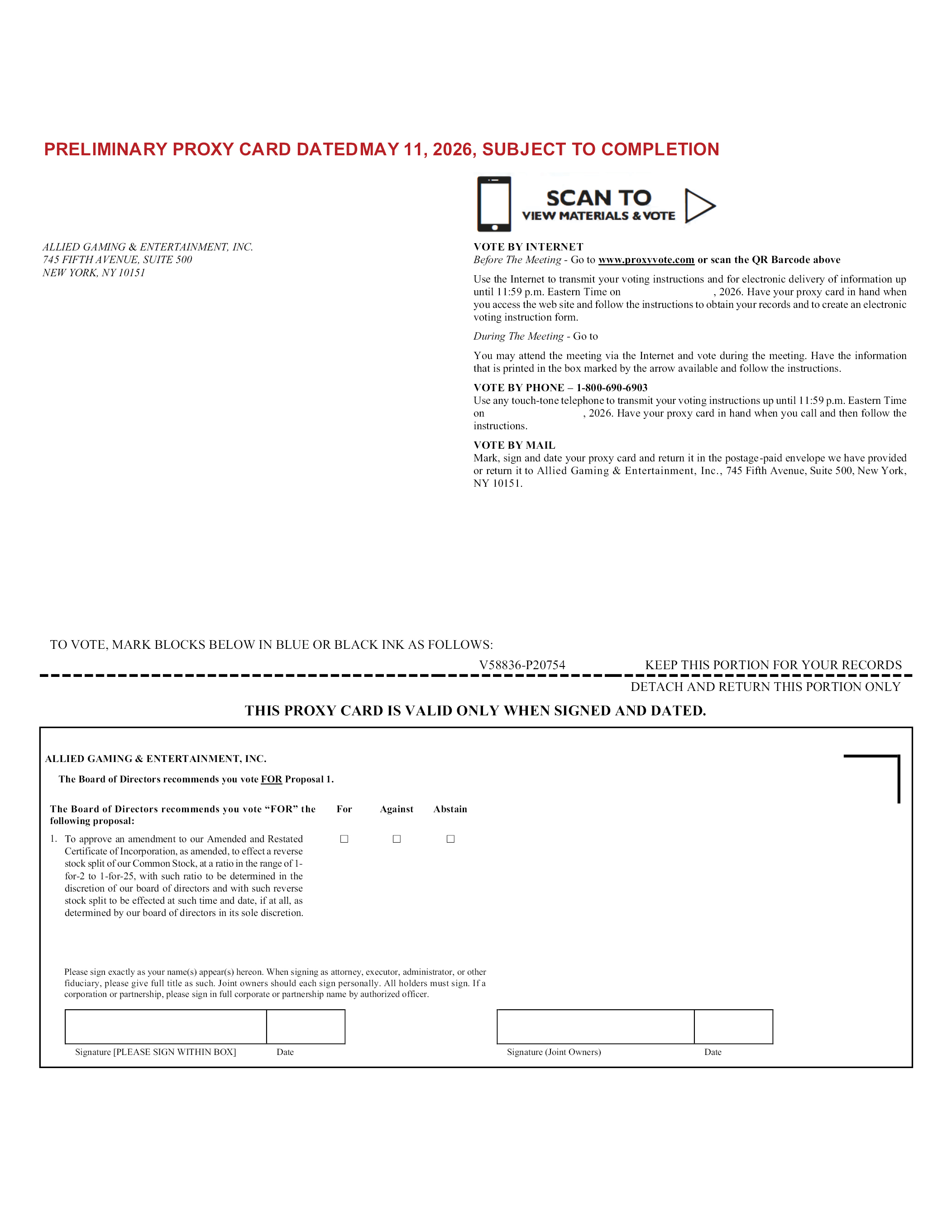
PRELIMINARY PROXY CARD DATED MAY 11, 2026, SUBJECT TO COMPLETION ALLIED GAMING & ENTERTAINMENT, INC. 745 Fifth Avenue, Suite 500 New York, NY10151 VOTE BY INTERNET Before The Meeting - Go to www.proxyvote.com or scan the QR Barcode above Use the Internet to transmit your voting instructions and for electronic delivery of information up until 11:59 p.m. Eastern Time on , 2026. Have your proxy card in hand when you access the web site and follow the instructions to obtain your records and to create an electronic voting instruction form. During The Meeting - Go to You may attend the meeting via the Internet and vote during the meeting. Have the information that is printed in the box marked by the arrow available and follow the instructions. VOTE BY PHONE – 1-800-690-6903 Use any touch-tone telephone to transmit your voting instructions up until 11:59 p.m. Eastern Time on , 2026. Have your proxy card in hand when you call and then follow the instructions. VOTE BY MAIL Mark, sign and date your proxy card and return it in the postage-paid envelope we have provided or return it to Allied Gaming & Entertainment, Inc.,745 Fifth Avenue, Suite 500, New York, NY 10151. TO VOTE, MARK BLOCKS BELOW IN BLUE OR BLACK INK AS FOLLOWS: V58836-P20754 KEEP THIS PORTION FOR YOUR RECORDS DETACH AND RETURN THIS PORTION ONLY THIS PROXY CARD IS VALID ONLY WHEN SIGNED AND DATED. ALLIED GAMING & ENTERTAINMENT, INC. The Board of Directors recommends you vote FOR Proposal 1. The Board of Directors recommends you vote “FOR” the following proposal: For Against Abstain 1. To approve an amendment to our Amended and Restated Certificate of Incorporation, as amended, to effect a reverse stock split of our Common Stock, at a ratio in the range of 1-for-2 to 1-for-25, with such ratio to be determined in the discretion of our board of directors and with such reverse stock split to be effected at such time and date, if at all, as determined by our board of directors in its sole discretion. Please sign exactly as your name(s) appear(s) hereon. When signing as attorney, executor, administrator, or other fiduciary, please give full title as such. Joint owners should each sign personally. All holders must sign. If a corporation or partnership, please sign in full corporate or partnership name by authorized officer. Signature [PLEASE SIGN WITHIN BOX] Date Signature (Joint Owners) Date
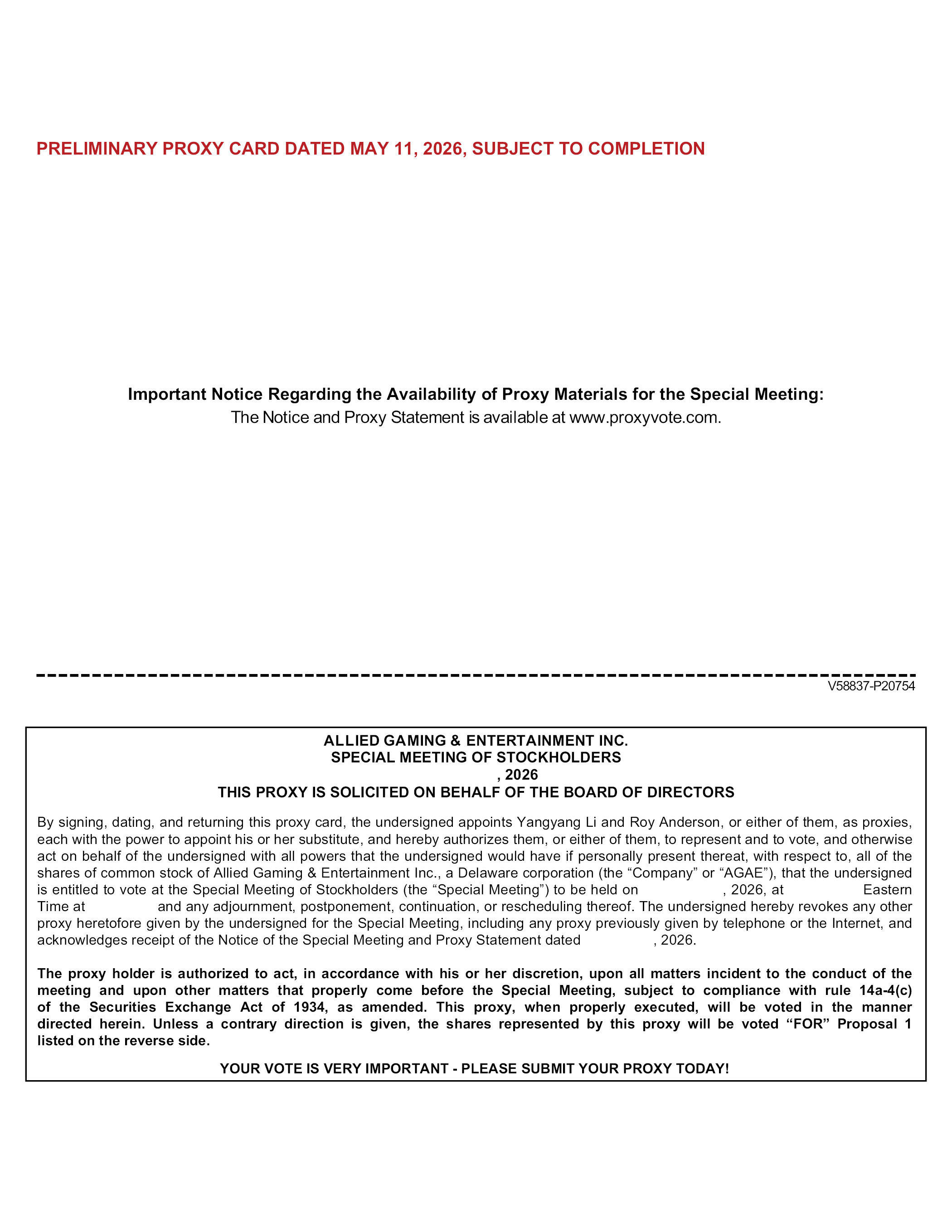
PRELIMINARY PROXY CARD DATED MAY 11, 2026, SUBJECT TO COMPLETION Important Notice Regarding the Availability of Proxy Materials for the Special Meeting: The Notice and Proxy Statement is available at www.proxyvote.com. V58837-P20754 ALLIED GAMING & ENTERTAINMENT INC. SPECIAL MEETING OF STOCKHOLDERS , 2026 THIS PROXY IS SOLICITED ON BEHALF OF THE BOARD OF DIRECTORS By signing, dating, and returning this proxy card, the undersigned appoints Yangyang Li and Roy Anderson, or either of them, as proxies, each with the power to appoint his or her substitute, and hereby authorizes them, or either of them, to represent and to vote, and otherwise act on behalf of the undersigned with all powers that the undersigned would have if personally present thereat, with respect to, all of the shares of common stock of Allied Gaming & Entertainment Inc., a Delaware corporation (the “Company” or “AGAE”), that the undersigned is entitled to vote at the Special Meeting of Stockholders (the “Special Meeting”) to be held on , 2026, at Eastern Time at and any adjournment, postponement, continuation, or rescheduling thereof. The undersigned hereby revokes any other proxy heretofore given by the undersigned for the Special Meeting, including any proxy previously given by telephone or the Internet, and acknowledges receipt of the Notice of the Special Meeting and Proxy Statement dated , 2026. The proxy holder is authorized to act, in accordance with his or her discretion, upon all matters incident to the conduct of the meeting and upon other matters that properly come before the Special Meeting, subject to compliance with rule 14a-4(c) of the Securities Exchange Act of 1934, as amended. This proxy, when properly executed, will be voted in the manner directed herein. Unless a contrary direction is given, the shares represented by this proxy will be voted “FOR” Proposal 1 listed on the reverse side. YOUR VOTE IS VERY IMPORTANT - PLEASE SUBMIT YOUR PROXY TODAY!