TABLE OF CONTENTS

UNITED STATES
SECURITIES AND EXCHANGE COMMISSION
Washington, DC 20549
SCHEDULE 14A
Proxy Statement Pursuant to Section 14(a) of the Securities Exchange Act of 1934
(Amendment No.)
Filed by the Registrant
Filed by a Party other than the Registrant
Check the appropriate box:

Preliminary Proxy Statement

Confidential, for Use of the Commission Only (as permitted by Rule 14a-6(e)(2))

Definitive Proxy Statement

Definitive Additional Materials

Soliciting Material Pursuant to § 240.14a-12
ALLIED GAMING & ENTERTAINMENT, INC.
(Name of Registrant as Specified In Its Charter)
 
(Name of Person(s) Filing Proxy Statement if Other Than the Registrant)
Payment of Filing Fee (Check all boxes that apply)

No fee required.

Fee paid previously with preliminary materials.

Fee computed on table in exhibit required by Item 25(b) per Exchange Act Rules 14a-6(i)(1) and 0-11.

TABLE OF CONTENTS

PRELIMINARY PROXY STATEMENT
SUBJECT TO COMPLETION DATED DECEMBER 30, 2025

ALLIED GAMING & ENTERTAINMENT, INC.
745 Fifth Avenue, Suite 500
New York, New York 10151

NOTICE OF SPECIAL MEETING OF STOCKHOLDERS
To Be Held On January 30, 2026
Dear Stockholders of Allied Gaming & Entertainment, Inc.:
You are cordially invited to virtually attend a special meeting of the stockholders (the “Special Meeting”) of Allied Gaming & Entertainment, Inc., a Delaware corporation (“Allied,” “we,” “us,” “our,” or the “Company”). The meeting will be held on January 30, 2026 at 10 a.m. Eastern Time. To facilitate stockholder participation and save costs, the Special Meeting will be held in a virtual meeting format only at [•]. The meeting will be held for the following purposes:
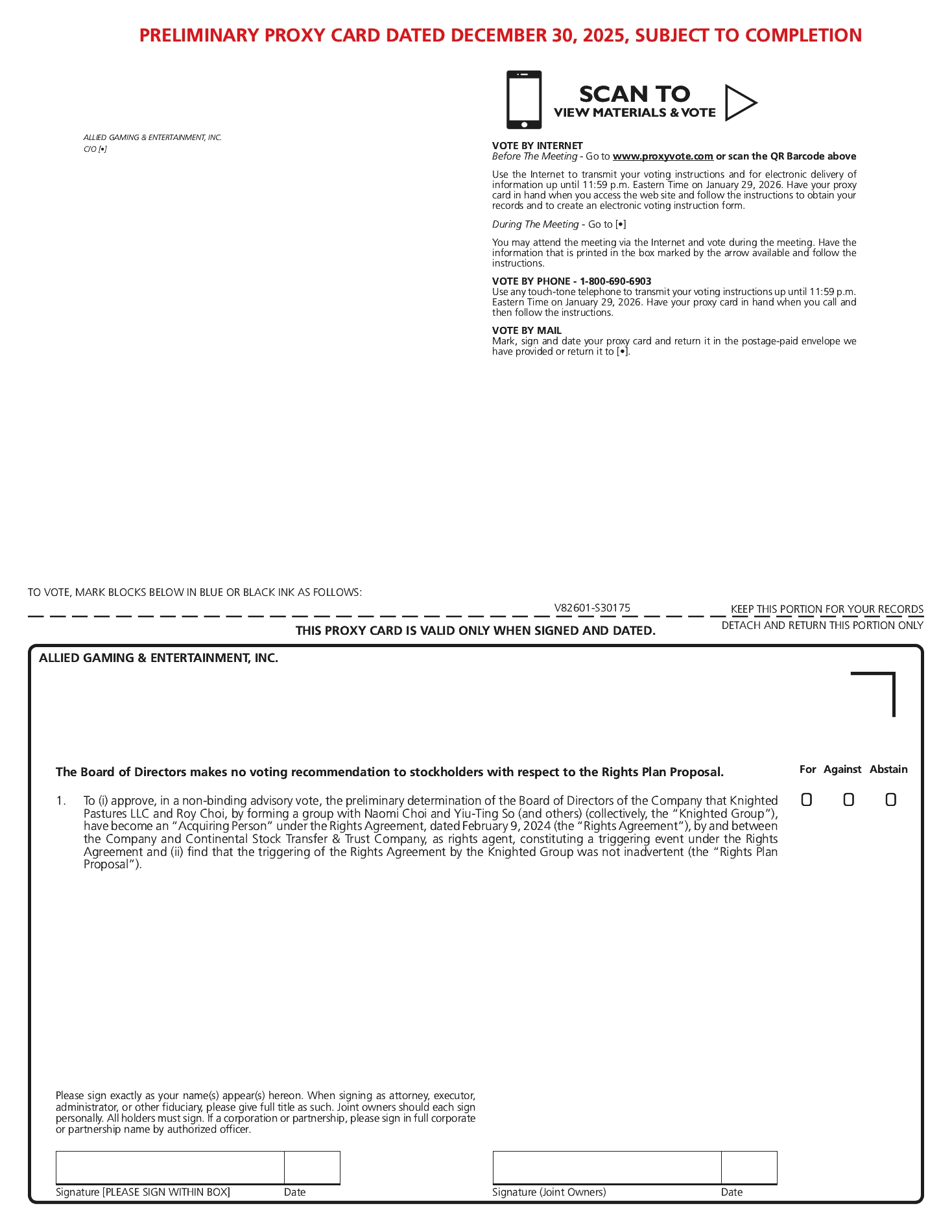
To (i) approve, in a non-binding advisory vote, the preliminary determination of the Board of Directors of the Company (the “Board”) that Knighted Pastures LLC (“Knighted”) and Roy Choi, by forming a group with Naomi Choi and Yiu-Ting So (and others) (collectively, the “Knighted Group”), have become an “Acquiring Person” under the Rights Agreement, dated February 9, 2024 (the “Rights Agreement”), by and between the Company and Continental Stock Transfer & Trust Company, as rights agent, constituting a triggering event under the Rights Agreement and (ii) find that the triggering of the Rights Agreement by the Knighted Group was not inadvertent (the “Rights Plan Proposal”).
These items of business are more fully described in the proxy statement (the “Proxy Statement”) accompanying this notice (“Notice”).
In addition to the foregoing, the Special Meeting will include the transaction of any other business relating to the purpose or purposes stated in this Notice and the accompanying Proxy Statement that may be properly brought before the meeting or any continuation, adjournment or postponement thereof.
The record date for the Special Meeting is December 31, 2025. Only stockholders of record at the close of business on that date may vote on the proposal being presented at the Special Meeting or any adjournment, postponement, rescheduling, or continuation thereof.
Important Notice Regarding the Availability of Proxy Materials for the Special Meeting to Be Held Virtually on January 30, 2026 at 10 a.m. Eastern Time at [•].
The Proxy Statement is available at [•].
By Order of the Board of Directors,


Yangyang Li
Chief Executive Officer
January    , 2026
Whether or not you expect to attend the virtual meeting, please complete, date, sign and return the enclosed proxy, or vote over the telephone or the Internet as instructed in these materials, as promptly as possible in order to ensure your representation at the meeting. Even if you have voted by proxy, you may still vote if you attend the virtual meeting. Please note, however, that if your shares are held of record by a broker, bank or other nominee and you wish to vote at the virtual meeting, you must obtain a proxy issued in your name from that record holder.

TABLE OF CONTENTS

i

TABLE OF CONTENTS

PRELIMINARY PROXY STATEMENT - SUBJECT TO COMPLETION
ALLIED GAMING & ENTERTAINMENT, INC.
745 Fifth Avenue, Suite 500
New York, New York 10151
PROXY STATEMENT
FOR THE SPECIAL MEETING OF STOCKHOLDERS
To be held on January 30, 2026
QUESTIONS AND ANSWERS ABOUT THESE PROXY MATERIALS AND VOTING
When is this Proxy Statement and accompanying proxy card (“Proxy Card”) first being mailed to stockholders?
This Proxy Statement and Proxy Card are first being mailed on or about January    , 2026 to stockholders of record entitled to vote at the Special Meeting.
How do I attend the Special Meeting?
In order to facilitate stockholder participation and save costs, the meeting will be held virtually on January 30, 2026 at 10 a.m. Eastern Time. There will not be a physical meeting. We have worked to offer the same participation opportunities as if you attended the Special Meeting in person and hope the online format will allow more stockholders to participate by removing any barriers caused by travel requirements. You may attend the Special Meeting online, including voting and submitting questions, at [•] by entering the 16-digit control number included on your Proxy Card. You should ensure you have a strong Internet connection wherever you intend to participate in the Special Meeting. We encourage you to access the Special Meeting before it begins. Online check-in will begin at 9:30 a.m. Eastern Time on the date of the Special Meeting.
Our virtual meeting provider facilitates stockholders’ opportunity to ask questions during the meeting. The Special Meeting site will provide stockholders with information regarding (i) time guidelines for their questions, rules around what types of questions are allowed, and rules for how questions and comments will be recognized and disclosed to meeting participants; and (ii) procedures for posting appropriate questions received during the meeting. Once you are logged into the Special Meeting, you will be able to submit your questions directly to the Company. Our virtual meeting will be governed by our rules of conduct and procedures, which will be posted at [•] in advance of the Special Meeting.
You may obtain instructions for how to access the Special Meeting online at [•]. If you encounter any difficulties accessing the virtual meeting during the check-in or meeting time or need support in addressing technical and logistical issues related to accessing the virtual meeting platform, a technical assistance phone number will be made available on the virtual meeting registration page at [•], 30 minutes prior to the start of the meeting.
Who can vote at the Special Meeting?
Only stockholders of record at the close of business on December 31, 2025 (the “Record Date”) will be entitled to vote on the proposal being presented at the Special Meeting. On the Record Date, there were     shares of common stock of the Company outstanding and entitled to vote.
Stockholder of Record: Shares Registered in Your Name
If on December 31, 2025, your shares were registered directly in your name with the Company’s transfer agent, Continental Stock Transfer & Trust Company, then you are a stockholder of record. As a stockholder of record, you may vote by virtually attending the Special Meeting and voting during the Special Meeting or vote over the telephone or the Internet or by proxy card. Whether or not you plan to virtually attend the Special Meeting, we urge you to vote by proxy to ensure your vote is counted.
Beneficial Owner: Shares Registered in the Name of a Broker or Other Nominee
If on December 31, 2025, your shares were held, not in your name, but rather in an account at a brokerage firm, bank, dealer, other similar organization, or other nominee, then you are the beneficial owner of shares held in “street name” and these proxy materials are being forwarded to you by that organization. The organization holding your account is
1

TABLE OF CONTENTS

considered to be the stockholder of record for purposes of voting on the proposal being presented at the Special Meeting. As a beneficial owner, you have the right to direct your broker or other agent regarding how to vote the shares in your account. You are also invited to virtually attend the Special Meeting.
What am I voting on?
There is one matter scheduled for a vote:
To (i) approve, in a non-binding advisory vote, the preliminary determination of the Board of Directors of the Company (the “Board”) that Knighted Pastures LLC (“Knighted”) and Roy Choi, by forming a group with Naomi Choi and Yiu-Ting So (and others) (collectively, the “Knighted Group”), have become an “Acquiring Person” under the Rights Agreement, dated February 9, 2024 (the “Rights Agreement”), by and between the Company and Continental Stock Transfer & Trust Company, as rights agent, constituting a triggering event under the Rights Agreement and (ii) find that the triggering of the Rights Agreement by the Knighted Group was not inadvertent (the “Rights Plan Proposal”).
How does the Board recommend that I vote on the Rights Plan Proposal?
The Board has determined not to make a recommendation regarding the Rights Plan Proposal. Instead, the Board will wait and consider the views of our stockholders before making any final determination in connection with the Rights Agreement.
What if another matter is properly brought before the meeting?
The Board knows of no other matters that will be presented for consideration at the Special Meeting. If any other matters are properly brought before the meeting, it is the intention of the persons named in the accompanying Proxy Card to vote on those matters in accordance with their best judgment, subject to compliance with Rule 14a-4(c) of the Securities Exchange Act of 1934, as amended (the “Exchange Act”).
How do I vote?
All shares represented by valid proxies that we receive through this solicitation, and that are not revoked, will be voted in accordance with your instructions on the Proxy Card or as instructed via the Internet or telephone. You may specify whether your shares should be voted for, against, or abstain with respect to the proposal. Voting by proxy will not affect your right to attend the Special Meeting.
The procedures for voting are as follows:
Stockholder of Record: Shares Registered in Your Name
If you are a stockholder of record, you may vote by virtually attending the Special Meeting and voting during the Special Meeting, vote by proxy over the telephone, vote by proxy through the Internet or vote by proxy using a Proxy Card. Whether or not you plan to virtually attend the Special Meeting, we urge you to vote by proxy to ensure your vote is counted. You may still virtually attend the Special Meeting and vote during the Special Meeting even if you have already voted by proxy.
To vote using the Proxy Card, simply complete, sign and date the Proxy Card and return it promptly in the envelope provided. If you return your signed Proxy Card to us before the Special Meeting, we will vote your shares as you direct.
To vote over the telephone, dial toll-free [•] using a touch-tone phone and follow the recorded instructions. You will be asked to provide the company number and 16-digit control number included on your Proxy Card. Your telephone vote must be received by 11:59 p.m. Eastern Time on January 29, 2026 to be counted.
To vote through the Internet, go to [•] to complete an electronic proxy card. You will be asked to provide the company number and 16-digit control number from your Proxy Card. Your Internet vote must be received by 11:59 p.m. Eastern Time on January 29, 2026 to be counted.
If you virtually attend the Special Meeting, you can also vote during the Special Meeting by visiting [•] and entering the 16-digit control number included on your Proxy Card (if you received a printed copy of the proxy materials).
2

TABLE OF CONTENTS

Beneficial Owner: Shares Registered in the Name of Broker or Bank
If you are a beneficial owner of shares registered in the name of your broker, bank, or other nominee, you should have received voting instructions from that organization rather than from us. Simply follow the instructions in the voting instruction form to ensure that your vote is counted.
How many votes do I have?
On each matter to be voted upon, you have one vote for each share of common stock of the Company you own as of December 31, 2025.
What happens if I do not vote?
Stockholder of Record: Shares Registered in Your Name
If you are a stockholder of record and do not vote by completing your Proxy Card, or by telephone, through the Internet, or by virtually attending the Special Meeting and voting during the Special Meeting, your shares will not be voted.
Beneficial Owner: Shares Registered in the Name of Broker or Other Nominee
If you are a beneficial owner and do not instruct your broker, bank, or other agent how to vote your shares, the question of whether your broker or nominee will still be able to vote your shares depends on whether the particular proposal is a “routine” matter. Under the rules of the New York Stock Exchange (“NYSE”), which are also applicable to Nasdaq-listed companies, brokers, banks and other securities intermediaries that are subject to NYSE rules may use their discretion to vote your “uninstructed” shares on matters considered to be “routine” under NYSE rules but not with respect to “non-routine” matters. The Rights Plan Proposal is considered to be “non-routine” under NYSE rules such that your broker, bank or other agent may not vote your shares on such proposal in the absence of your voting instructions.
What if I return a Proxy Card or otherwise vote but do not make specific choices?
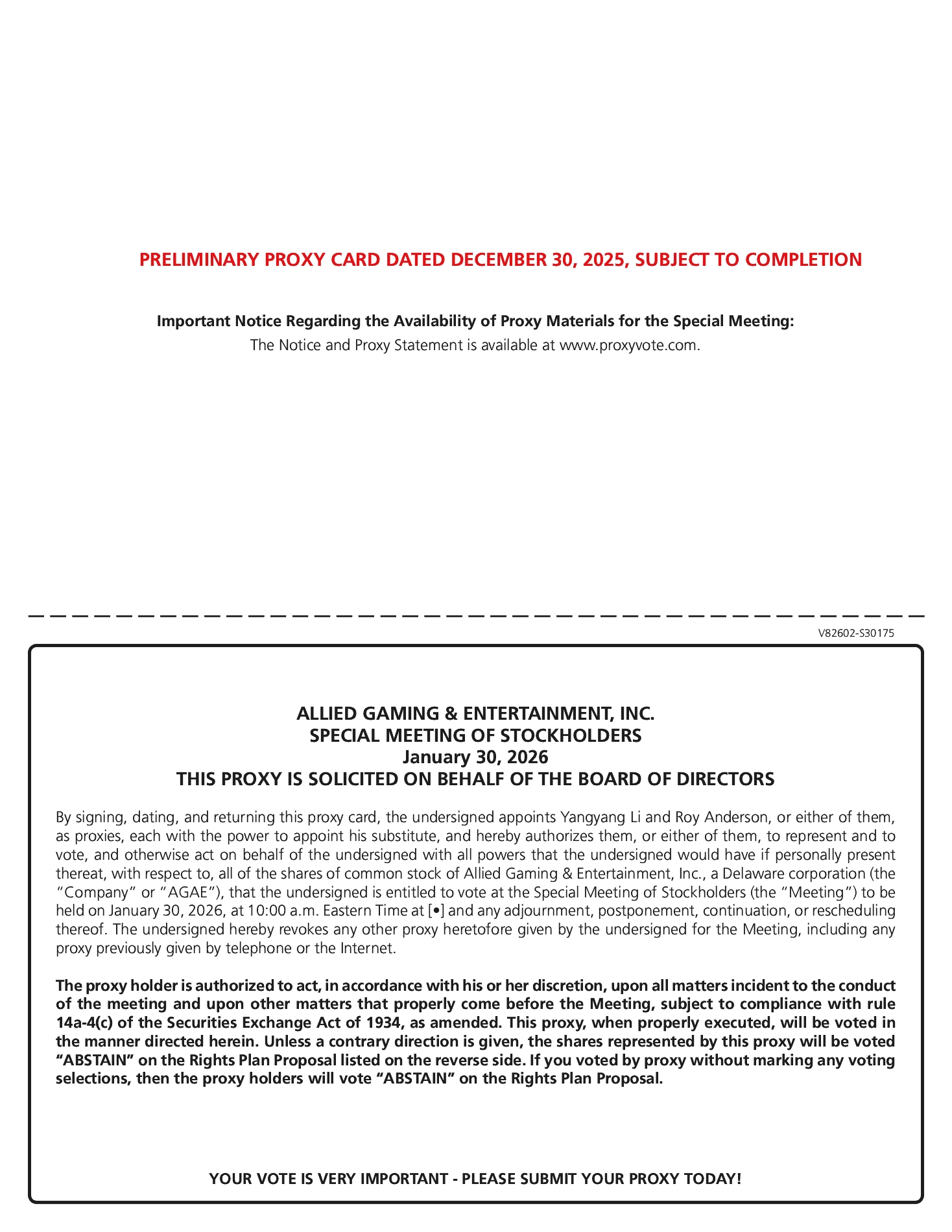
If you voted by proxy without marking any voting selections, then the proxy holders will vote “ABSTAIN” on the Rights Plan Proposal, and as the proxy holders may determine in their discretion with respect to any other matters properly presented for a vote at the Special Meeting.
Who is paying for this proxy solicitation?
We will pay for the entire cost of soliciting proxies. We may also reimburse brokerage firms, banks and other agents for the cost of forwarding proxy materials to beneficial owners.
What does it mean if I receive more than one Proxy Statement and Proxy Card?
If you receive more than one Proxy Statement and Proxy Card, your shares may be registered in more than one name or in different brokerage accounts. Please follow the voting instructions on the Proxy Cards to ensure that all of your shares are voted. Remember, you may vote by telephone, Internet or by signing, dating and returning a Proxy Card, or by voting at the Special Meeting.
Can I change my vote or revoke my proxy?
Stockholder of Record: Shares Registered in Your Name
Yes. You may change your vote or revoke your proxy at any time before the final vote at the Special Meeting. If you are the record holder of your shares, you may change your vote or revoke your proxy in any one of the following ways:
You may submit a properly completed Proxy Card with a later date.
You may grant a subsequent proxy by telephone or through the Internet.
You may send a timely written notice that you are revoking your proxy to our Corporate Secretary at our principal executive offices at 745 Fifth Avenue, Suite 500, New York, NY 10151.
3

TABLE OF CONTENTS

You may virtually attend the Special Meeting and vote online during the Special Meeting. Simply virtually attending the Special Meeting will not, by itself, revoke your proxy. You must specifically request at the Special Meeting that it be revoked.
Beneficial Owner: Shares Registered in the Name of Broker or Bank
If your shares are held by your broker or bank as a nominee or agent, you should follow the instructions provided by your broker or bank.
Your most current vote that is valid, whether by telephone, Internet or proxy card is the one that will be counted.
What are “broker non-votes”?
If you are a beneficial owner whose shares of record are held by a broker, you may instruct your broker how to vote your shares. If you do not give instructions to your broker, the broker will determine if it has the discretionary authority to vote on the particular matter. Under NYSE rules, which are also applicable to Nasdaq-listed companies, brokers, banks and other securities intermediaries that are subject to NYSE rules may use their discretion to vote your “uninstructed” shares on matters considered to be “routine” under NYSE rules but not with respect to “non-routine” matters.
A broker non-vote occurs when a broker, bank or other agent has not received voting instructions from the beneficial owner of the shares and the broker, bank or other agent cannot vote the shares because the matter is considered “non-routine” under NYSE rules. Broker non-votes, if any, will be counted for purposes of calculating whether a quorum is present at the meeting, but will not be counted for purposes of determining the number of votes cast with respect to a particular proposal.
The Rights Plan Proposal is a “non-routine” matter, and banks and brokerage firms may not vote your shares on such proposal in the absence of your voting instructions. Accordingly, no broker non-votes are expected to occur in connection with the Rights Plan Proposal.
How many votes are needed to approve the proposal?
The affirmative vote of the holders of a majority of the shares of common stock represented and entitled to vote at the meeting virtually or by proxy is required for the approval, on a non-binding advisory basis, of the Rights Plan Proposal. Abstentions will have the same effect as a vote “against” the Rights Plan Proposal. Broker non-votes, if any, will have no effect on the Rights Plan Proposal.
What is the quorum requirement and how will votes be counted?
A quorum of stockholders is necessary to hold a valid meeting. A quorum will be present if stockholders holding at least a majority of the issued and outstanding shares of common stock entitled to vote at the Special Meeting are deemed present at the Special Meeting, virtually or represented by proxy. On the record date, there were     shares outstanding and entitled to vote. Thus, the holders of     shares must be deemed present virtually or represented by proxy at the Special Meeting to have a quorum.
Your shares will be counted towards the quorum only if you submit a valid proxy (or one is submitted on your behalf by your broker, bank or other nominee) or if you vote electronically at the Special Meeting. Abstentions and broker non-votes, if any, will be counted towards the quorum requirement. If there is no quorum, the holders of a majority of the votes entitled to be cast by the stockholders entitled to vote thereat may adjourn the Special Meeting to another date.
How can I find out the results of the voting at the Special Meeting?
Preliminary voting results will be announced at the Special Meeting. In addition, final voting results will be published in a Current Report on Form 8-K that we expect to file within four business days after the Special Meeting. If final voting results are not available to us in time to file a Current Report on Form 8-K within four business days after the Special Meeting, we intend to file a Current Report on Form 8-K to publish preliminary results and, within four business days after the final results are known to us, file an additional Current Report on Form 8-K to publish the final results.
4

TABLE OF CONTENTS

What proxy materials are available on the Internet?
The Proxy Statement and Proxy Card are available at [•].
If you have any questions or need assistance in voting your shares, please contact us:
Allied Gaming & Entertainment, Inc.
745 Fifth Avenue, Suite 500
New York, NY 10151
Telephone: (646) 768-4240
5

TABLE OF CONTENTS

RIGHTS PLAN PROPOSAL
You are being asked, on an advisory basis, to (i) ratify the preliminary determination by the Board that Knighted and Roy Choi, by forming a group with Naomi Choi and Yiu-Ting So (and others), have become an “Acquiring Person” under the Rights Agreement, constituting a triggering event under the Rights Agreement and (ii) find that the triggering of the Rights Agreement by the Knighted Group (as defined below) was not inadvertent.
Background of the Rights Agreement
The Board adopted the Rights Agreement on February 9, 2024. On May 30, 2025, the Board approved Amendment No. 1 (the “Amendment”) to the Rights Agreement. The Board believes it is imperative that Allied stockholders are given the opportunity to realize the full long-term potential of their investment in the Company. The Board therefore adopted the Rights Agreement to prevent Allied stockholders from being deprived of that opportunity by any self-interested group taking control of the Company in a manner or at a price that is not in the best interest of all stockholders.
The Rights Agreement is similar to plans adopted by other publicly traded companies. It is intended to promote the fair and equal treatment of all Allied stockholders and ensure that no person or group can gain control of our Company through open market accumulation or other tactics potentially disadvantaging the interest of all stockholders. The Rights Agreement applies equally to all existing and future stockholders and is not intended to deter offers that are fair and otherwise in the best interest of the Company and all of its stockholders. For a summary of the terms of the Rights Agreement, see “—Summary of the Rights Agreement” below.
Reasons for Why the Board Believes the Rights Agreement Has Been Triggered
Based on the information available to the Board, Naomi Choi, Mr. Roy Choi’s mother, and Yiu-Ting So, a long-time business partner of Mr. Roy Choi (and others) (collectively with Knighted and Roy Choi, the “Knighted Group”) acquired shares of common stock of the Company during the term of the Rights Agreement. On June 11, 2025, the Company commenced a lawsuit against the Knighted Group in the U.S. District Court for the Central District of California (the “California Court”) for violations of Section 13(d) of the Securities Exchange Act of 1934, as amended (the “Exchange Act”), for failing to disclose the coordinated group of stockholders that acted together to acquire more than 5% of Allied’s stock which improperly deprived Allied and the market of material information. The lawsuit also alleges that Knighted and Roy Choi failed to comply with Allied’s bylaws. The Company filed a motion for preliminary injunction seeking certain preliminary relief to preserve the status quo. The preliminary injunction motion was heard on July 28, 2025 and, on August 1, 2025, the California Court granted in part and denied in part the Company’s motion. The California Court’s full order was entered on August 12, 2025 (the “August 12, 2025 Order”). The August 12, 2025 Order states that the Company has demonstrated it is reasonably likely to establish that the Knighted parties formed a group with Naomi Choi and Yiu-Ting So under Section 13(d) of the Exchange Act and succeed on the merits of its claims. The August 12, 2025 Order is attached as Appendix A to this proxy statement. Given that the Knighted Group was formed at a time when the Rights Agreement was in effect, the Board made a preliminary determination that the Knighted Group, including Knighted and Mr. Roy Choi, triggered the Rights Agreement. On October 17, 2025, Allied filed a motion for leave to file an amended complaint adding yet more parties to the Knighted Group. That motion is pending.
In response to potential inquiries and requests from stockholders of the Company regarding the implications of the August 12, 2025 Order vis a vis the Rights Agreement, the Board is asking stockholders of the Company to (i) confirm and ratify the Board’s preliminary determination that Knighted and Mr. Roy Choi triggered the Rights Agreement by forming a group with Naomi Choi and Yiu-Ting So (and others) thus becoming an “Acquiring Person” under the Rights Agreement and (ii) find that the triggering of the Rights Agreement by the Knighted Group was not inadvertent. Stockholders’ vote on this Rights Plan Proposal is advisory in nature and will not be binding on the Board; however, the Board will take the results of the vote into consideration in exercising its fiduciary duties and making any final determinations.
Effect of the Proposal
None of the Certificate of Incorporation of the Company (as amended or restated from time to time), the bylaws of the Company, or applicable law requires stockholder ratification of the Board’s preliminary determination that Knighted and Mr. Roy Choi triggered the Rights Agreement by forming a group with Naomi Choi and Yiu-Ting So (and others)
6

TABLE OF CONTENTS

thus becoming an “Acquiring Person” under the Rights Agreement or that the triggering of the Rights Agreement by the Knighted Group was not inadvertent. However, the Board considers the Rights Plan Proposal a matter on which stockholders should be permitted to express their view.
Because the Rights Plan Proposal is advisory in nature, the failure of this proposal to receive stockholder approval will not affect the validity, effectiveness, or operation of the Rights Agreement or the Board’s prior preliminary determination that the Knighted Group has become an “Acquiring Person” under the Rights Agreement, constituting a triggering event under the Rights Agreement, nor will it require the redemption, amendment, or termination of the Rights Agreement. No action by the Board is required as a result of obtaining or failing to obtain stockholder approval of the Rights Plan Proposal. However, the Board will consider the outcome of this advisory vote, together with its fiduciary duties under applicable law, in determining whether to take any future actions with respect to the Rights Agreement.
If the Board makes a final determination that the Rights Agreement has been triggered because the Knighted Group has become an “Acquiring Person” under the Rights Agreement and that the triggering of the Rights Agreement by the Knighted Group was not inadvertent, rights under the Rights Agreement beneficially owned by members of the Knighted Group, or any known transferees thereof (whether for value, by gift or otherwise) will automatically become void under the terms of the Rights Agreement, and the flip-in feature of the Rights Agreement will come into effect. Under the flip-in feature, each stockholder other than members of the Knighted Group or known transferees thereof will be given the opportunity to purchase shares of common stock of the Company at a 50% discount to the current market price.
Rather than using the flip-in feature, the Board may, at its option, direct the Company to exchange (the “Exchange”) all or part of the then outstanding and exercisable rights (which do not include rights beneficially owned by members of the Knighted Group or any known transferees thereof (whether for value, by gift or otherwise) that have become void) for shares of common stock of the Company at an exchange ratio of one share of common stock per right (the “Exchange Shares”). While no final decision has been made and the Board reserves its rights to consider all facts and circumstances pertaining to this matter in making any determination, the Board anticipates it would conduct an Exchange if it determines that the Rights Agreement has been triggered and that such triggering was not inadvertent, rather than using the flip-in feature.
As of the date of the Exchange, all valid and outstanding existing rights would be cancelled and converted into the right to receive the Exchange Shares. We expect the Exchange would double the number of shares of common stock owned by each stockholder of record as of the date of the Exchange, other than members of the Knighted Group, or known third parties to which the Knighted Group transferred shares for value, by gift or otherwise, following the triggering date of the Rights Agreement.
In addition, if the Board determines that the Rights Agreement was triggered and that the triggering of the Rights Agreement by the Knighted Group was not inadvertent and the Company issues shares pursuant to the Rights Agreement, the Board may also, in its discretion, determine to reload the Rights Agreement by amending or restating the Rights Agreement or adopting a rights agreement on substantially similar terms thereby maintaining the continued effectiveness of the Rights Agreement, subject to applicable law and court orders.
Summary of the Rights Agreement
The following is a summary of the terms of the Rights Agreement. All capitalized terms not defined in this summary have the meanings ascribed to such terms in the Rights Agreement. This summary and each statement contained in this summary is qualified in its entirety by reference to the complete text of the Rights Agreement (including Amendment No. 1 thereto), a copy of the Rights Agreement and Amendment No. 1 is attached as Exhibit 4.1 to the Company’s Current Report on Form 8-K filed with the SEC on February 9, 2024 and as Exhibit 4.1 to the Company’s Current Report on Form 8-K filed with the SEC on June 5, 2025 (available on the SEC’s website at https://www.sec.gov/ix?doc=/Archives/edgar/data/1708341/000092963824000492/a8k.htm and https://www.sec.gov/Archives/edgar/data/1708341/000092963825002178/exhibit4-1.htm), respectively, and incorporated herein by reference. We urge you to carefully read the Rights Agreement in its entirety, including the amendments thereto, as the discussion below is only a summary.
The Rights
Subject to the terms, provisions and conditions of the Rights Agreement, if the Rights become exercisable, each Right would initially represent the right to purchase from the Company one one-thousandth of a share of a newly-designated
7

TABLE OF CONTENTS

series of preferred stock, Series A Junior Participating Preferred Stock, par value $0.0001 per share, of the Company (each, a “Series A Preferred Share” and, collectively, the “Series A Preferred Shares”), at an exercise price of $7.00 per one one-thousandth of a Series A Preferred Share, subject to adjustment as provided in the Rights Agreement (the “Exercise Price”). If issued, each one one-thousandth of a Series A Preferred Share would give the stockholder approximately the same dividend, voting, and liquidation rights as does one share of common stock. However, prior to exercise, a Right does not give its holder any right as a stockholder of the Company, including, without limitation, any dividend, voting, or liquidation rights. A copy of the Certificate of Designation of Series A Junior Participating Preferred Stock of the Company was filed by the Company with the Secretary of State of the State of Delaware on February 9, 2024, to designate the Series A Preferred Shares and was filed with the SEC as Exhibit 3.1 to the Company’s Current Report on Form 8-K on February 9, 2024 and is incorporated herein by reference.
Initial Exercisability
Initially, the Rights will not be exercisable, certificates evidencing the Rights will not be sent to stockholders and the Rights will automatically transfer with the transfer of the underlying Common Shares. Until the Rights separate from the Common Shares and become exercisable (or the earlier redemption date or final expiration date of the Rights), the Rights will be evidenced by Common Share certificates and the Rights relating to any uncertificated Common Shares that are registered in book entry form will be represented by a notation in book entry on the records of the Company. The surrender for transfer of any Common Shares will also constitute the transfer of the associated Rights.
Subject to certain exceptions specified in the Rights Agreement, the Rights will separate from the Common Shares and become exercisable following the earlier to occur of the close of business on (i) the tenth (10th) business day after the Shares Acquisition Date (as defined below) (or such later date as may be determined by the Board to effect an exchange in accordance with the Rights Agreement, such later date to be not more than twenty (20) days after the Shares Acquisition Date) or (ii) the tenth (10th) business day (or such later date as may be determined by the Board prior to the such time as any person becomes an Acquiring Person (as defined below)) after the date that a tender or exchange offer by any person (other than certain exempted persons) is first published or sent or given within the meaning of Rule 14d-2(a) of the applicable rules and regulations promulgated under the Exchange Act, the consummation of which would result in any person becoming an Acquiring Person (the earlier of these dates is called the “Distribution Date”). “Shares Acquisition Date” means the earlier of the date of (i) the public announcement by the Company or an Acquiring Person that an Acquiring Person has become such or (ii) the public disclosure of facts by the Company or an Acquiring Person indicating that an Acquiring Person has become such.
After the Distribution Date, separate rights certificates will be issued to each record holder of Common Shares as of the close of business on the Distribution Date (other than any Acquiring Person or any Associate or Affiliate (each as defined in the Rights Agreement) of such Acquiring Person) and the Rights may be transferred other than in connection with the transfer of the underlying Common Shares unless and until the Board has determined to effect an exchange pursuant to the Rights Agreement (as described below).
Acquiring Person
Under the Rights Agreement, an Acquiring Person is any person who or that, together with all Affiliates and Associates of such person is or becomes the beneficial owner of ten percent (10%) or more of the Common Shares then outstanding, subject to various exceptions. For purposes of the Rights Agreement, beneficial ownership is defined to include the ownership of derivative securities.
The Rights Agreement provides that an Acquiring Person does not include (i) the Company, (ii) any subsidiary of the Company, or (iii) any employee benefit plan of the Company or any subsidiary of the Company, or any person holding Common Shares for or pursuant to the terms of any such employee benefit plan to the extent such Common Shares are held for or pursuant to the terms of any such employee benefit plan.
The Rights Agreement also provides that the following persons shall not be or become an Acquiring Person thereunder: (i) as the result of an acquisition of Common Shares by the Company which, by reducing the number of shares outstanding, increases the proportionate number of shares beneficially owned by such person to 10% or more of the outstanding Common Shares; provided, however, that if such person becomes the beneficial owner of an additional 0.001% of the outstanding Common Shares, then such person shall be deemed to be an Acquiring Person; and (ii) subject to certain conditions set forth in the Rights Agreement, if the Board determines in good faith that a person who would otherwise be an Acquiring Person, has become such inadvertently (including, without limitation, because (A) such person was unaware that it beneficially owned a percentage of the then-outstanding Common Shares that
8

TABLE OF CONTENTS

would otherwise cause such person to be an “Acquiring Person,” or (B) such person was aware of the extent of its beneficial ownership of Common Shares, but had no actual knowledge of the consequences of such beneficial ownership under the Rights Agreement and had no intention of changing or influencing control of the Company), and such person divests as promptly as practicable beneficial ownership of a sufficient number of Common Shares so that such person would no longer be an “Acquiring Person” or if such divestiture requirement is waived by the Board on such terms and conditions as the Board, in good faith, determines are advisable.
“Grandfathering” of Existing Holders
The Rights Agreement also provides that any person who is the beneficial owner, as of the time of the first public announcement of the declaration of the Rights dividend, of ten percent (10%) or more of the outstanding Common Shares (each a “Grandfathered Stockholder”), shall not be deemed to be an “Acquiring Person” unless and until a Grandfathered Stockholder subsequently acquires beneficial ownership of additional shares of the then-outstanding Common Shares to an amount equal to or greater than the greater of (x) 10% or (y) the sum of (i) the lowest beneficial ownership of such person as a percentage of the outstanding Common Shares as of any time from and after the time of the first public announcement of the declaration of the Rights dividend plus (ii) 0.001%. For the avoidance of doubt any Person that purchases shares of Common Shares from the Company pursuant to an agreement with the Company that is in effect as of the time of the first public announcement of the declaration of the Rights dividend and would otherwise be an “Acquiring Person” as a result of such purchase is deemed to be the Beneficial Owner of 10% or more and to be a Grandfathered Stockholder, subject to the terms and conditions of the Grandfathered Stockholder provision.
Flip-In Trigger
If a person becomes an Acquiring Person, then, following the occurrence of the Distribution Date and subject to the terms, provisions, and conditions of the Rights Agreement, each holder of a Right (except for Rights that have previously been voided as set forth below) will have the right to receive from the Company, upon exercise and payment of the then current Exercise Price, in lieu of a number of one one-thousandths of a Series A Preferred Share, a number of Common Shares (or, in certain circumstances, cash, property or other securities of the Company) having a then-current market value of twice the Exercise Price.
Following the occurrence of an event set forth in the preceding paragraph, all Rights that are or, under certain circumstances specified in the Rights Agreement, were beneficially owned by an Acquiring Person or an Associate or Affiliate of an Acquiring Person or certain of its transferees will become null and void and nontransferable.
Flip-Over Trigger
If, after a person becomes an Acquiring Person, (i) the Company consolidates with or merges with and into another entity and the Company is not the surviving corporation, (ii) any person consolidates with or merges with and into the Company and the Company is the surviving corporation of such merger and, in connection with such merger or consolidation, all or part of the outstanding Common Shares are changed into or exchanged for stock or other securities of any other person (or the Company) or cash or any other property, or (iii) the Company (or one or more of its Subsidiaries) sells or transfers fifty percent (50%) or more of the assets or earning power of the Company and its subsidiaries, taken as a whole, to any third party, then, in each case, each holder of a Right (except for Rights that have previously been voided as set forth above) will have the right to receive, upon exercise and payment of the current Exercise Price, in accordance with the terms of the Rights Agreement, a number of shares of common stock of the Principal Party (as defined in the Rights Agreement) having a then-current market value of twice the Exercise Price.
Redemption of the Rights
At any time until the earlier of (i) such time as any person becomes an Acquiring Person and (ii) the final expiration date, the Board may, at its option and in its sole discretion, direct the Company to, and, if directed by the Board, the Company will redeem the Rights in whole, but not in part, at a price of $0.0001 per Right, subject to adjustment in accordance with the Rights Agreement (the “Redemption Price”). The redemption of the Rights may be made effective at such time, on such basis and subject to such conditions as the Board in its sole discretion may establish. The Company may, at its option, pay the Redemption Price in cash, Common Shares (based on the current market price of the Common Shares at the time of redemption) or any other form of consideration deemed appropriate by the Board. Immediately upon the time of the effectiveness of any redemption of the Rights, the right to exercise the Rights will terminate and the only right of the holders of Rights will be to receive the Redemption Price for each Right so held.
9

TABLE OF CONTENTS

Exchange of the Rights
At any time after any person becomes an Acquiring Person, and prior to the time where any person becomes the beneficial owner of a majority of the outstanding Common Shares, the Board may, at its option, direct the Company to, and if directed by the Board, the Company will exchange all or part of the then outstanding and exercisable Rights (other than Rights held by the Acquiring Person or any Affiliate or Associate thereof, which would have become null and void and nontransferable in accordance with the terms of the Rights Agreement) for Common Shares at an exchange ratio (subject to adjustment) of one Common Share for each Right.
In any exchange of the Rights pursuant to the Rights Agreement, the Company, at its option, may substitute Series A Preferred Shares or common stock equivalents for Common Shares exchangeable for Rights at the initial rate of one one-thousandth of a Series A Preferred Share (or an appropriate number of common stock equivalents) for each Common Share, as appropriately adjusted so that the fraction of a Series A Preferred Share delivered in lieu of each Common Share shall have the same voting rights as one Common Share, subject to adjustment in accordance with the Rights Agreement. The exchange of the Rights may be made effective at such time, on such basis, and subject to such conditions as the Board in its sole discretion may establish. Immediately upon the action of the Board directing the Company to exchange the Rights, the right to exercise the Rights will terminate, and the only right thereafter of the holders of Rights will be to receive that number of Common Shares equal to the number of such Rights held by such holder multiplied by the exchange ratio.
Expiration of the Rights
The Rights and the Rights Agreement will expire upon the earliest to occur of (i) the date on which all of the Rights are redeemed, (ii) the date on which the Rights are exchanged, and (iii) the close of business on February 9, 2027, the final expiration date.
Amendment of Rights Agreement
Except as otherwise provided in the Rights Agreement, the Company, by action of the Board, may from time to time and in the sole and absolute discretion of the Board, supplement or amend the Rights Agreement without the approval of any holders of Rights to (i) cure any ambiguity in the Rights Agreement, (ii) correct or supplement any provision contained in the Rights Agreement that may be defective or inconsistent with any other provisions contained therein, (iii) shorten or lengthen any time period in the Rights Agreement, or (iv) make any change to or delete any provision of the Rights Agreement or to adopt any other provisions with respect to the Rights which the Company may deem necessary or desirable; provided, however, that from and after such time as any person becomes an Acquiring Person, the Rights Agreement may not be supplemented or amended in any manner that would adversely affect the interests of the holders of Rights (other than Rights that have become null and void pursuant to the Rights Agreement). Without limiting the foregoing, the Company, by action of the Board, may at any time before any person becomes an Acquiring Person amend the Rights Agreement to make the provisions of the Rights Agreement inapplicable to a particular transaction by which a person might otherwise become an Acquiring Person or to otherwise alter the terms and conditions of the Rights Agreement as they may apply with respect to any such transaction.
Rights of Holders
Until a Right is exercised, a Right does not give its holder any right as a stockholder of the Company, including, without limitation, any dividend, voting, or liquidation rights.
Anti-Dilution Provisions
The Board may adjust the Exercise Price, the number of Series A Preferred Shares issuable and the number of outstanding Rights to prevent dilution that may occur from a stock dividend, a stock split, or a reclassification of the Series A Preferred Shares or Common Shares.
With certain exceptions, no adjustments to the Exercise Price will be required until the cumulative adjustments amount to at least one percent (1%) of the Exercise Price. No fractional Series A Preferred Shares will be issued other than fractions that are integral multiples of one one-thousandth of a share and, in lieu thereof, an adjustment in cash will be made based on the current market price of the Series A Preferred Shares.
10

TABLE OF CONTENTS

Tax Consequences
The adoption of the Rights Agreement and the subsequent distribution of the Rights to stockholders should not be a taxable event for the Company or its stockholders under presently existing U.S. federal income tax laws. However, if the Rights become exercisable or if the Rights are redeemed, stockholders may recognize taxable income, depending on the circumstances then existing.
Accounting Treatment
The distribution of the Rights as a dividend to the Company’s stockholders has not had any financial accounting or reporting impact. Additionally, the Rights do not meet the definition of a liability under generally accepted accounting principles in the United States and are therefore not accounted for as a long-term obligation.
Authority of the Board
When evaluating decisions relating to the redemption of the Rights or any amendment to the Rights Agreement to delay or prevent the Rights from detaching and becoming exercisable as a result of a particular transaction, pursuant to the Rights Agreement, the Board, or any future board of directors, would not be subject to restrictions such as those commonly known as “dead-hand,” “slow-hand,” “no-hand,” or similar provisions. Nothing in the Rights Agreement, express or implied, including any provision requiring or permitting the Board to take (or refrain from taking) any action or making any determination will be deemed to modify, limit or eliminate the fiduciary duties of the Board under applicable law.
Certain Anti-Takeover Effects
The Rights are not intended to prevent a takeover of the Company and should not interfere with any merger or other business combination that the Board determines is in the best interests of the Company and its stockholders and that is approved by the Board. However, the Rights may cause substantial dilution to a person or group that acquires beneficial ownership of ten percent (10%) or more of the outstanding Common Shares (which includes for this purpose stock referenced in derivative transactions and securities) without the approval of the Board.
SEC Registration
Since the Rights are not exercisable immediately, registration with the SEC of the Series A Preferred Shares issuable upon exercise of the Rights is not required until the Rights become exercisable.
Required Vote
The affirmative vote of the holders of a majority of the shares of common stock represented and entitled to vote at the meeting virtually or by proxy is required for the approval of the Rights Plan Proposal. Abstentions will have the same effect as a vote “against” the Rights Plan Proposal. Broker non-votes, if any, will have no effect on the Rights Plan Proposal.
THE BOARD OF DIRECTORS MAKES NO VOTING RECOMMENDATION TO STOCKHOLDERS WITH RESPECT TO THE RIGHTS PLAN PROPOSAL.
11

TABLE OF CONTENTS

Security Ownership Of
Certain Beneficial Owners And Management
The table below sets forth information known to us regarding the beneficial ownership of our common stock as of December 26, 2025, for:
each person we believe beneficially holds more than 5% of our outstanding common shares (based solely on our review of SEC filings); and
all of our current directors and executive officers as a group.
The number of shares beneficially owned by a person includes shares issuable under options, warrants and other securities convertible into common stock held by that person and that are currently exercisable or that become exercisable within 60 days of December 26, 2025. Percentage calculations assume, for each person and group, that all shares that may be acquired by such person or group pursuant to options, warrants and other convertible securities currently exercisable or that become exercisable within 60 days of December 26, 2025, are outstanding. Nevertheless, shares of common stock that are issuable upon exercise of presently unexercised options, warrants and other convertible securities are not deemed to be outstanding for purposes of calculating the “Percentage of Shares Beneficially Owned” by any other person or any other group.
Except as otherwise indicated in the table or its footnotes, the persons in the table below have sole voting and investment power with respect to all shares of common stock shown as beneficially owned by them, subject to community property laws where applicable.
As of December 26, 2025, we had 37,706,930 shares of common stock issued and outstanding.
Name and Address of Beneficial Owners(1)
Shares
Beneficially
Owned
Percentage of
Shares
Beneficially
Owned
Five Percent Stockholders:
 
 
Primo Vital Ltd.(2)
11,986,523
31.8%
Greater Kansas City Community Foundation(3)
3,200,000
8.5%
Directors and Named Executive Officers:
 
 
Yinghua Chen(4)
830,575
2.2%
Roy Anderson(5)
20,381
*
Mao Sun
Yangyang Li(6)
70,000
*
Jingsheng (Jason) Lu(7)
12,046,523
31.9%
Guanzhou (Jerry) Qin(8)
30,000
*
Yushi Guo(9)
30,000
*
Yuanfei Qu(10)
20,000
*
Chi Zhao
All current directors and executive officers, as a group (9 individuals)
13,047,479(11)
34.6%(11)
*
Less than 1%
(1)
Unless otherwise noted, the business address of each of the following entities or individuals is 745 Fifth Ave, Suite 500, New York, NY 10151. Unless otherwise indicated, we believe that all persons named in the table have sole voting and investment power with respect to all shares of common stock beneficially owned by them.
(2)
Based on a joint Schedule 13D/A filed on December 11, 2024, filed by Primo Vital Ltd. (“Primo”), Ourgame International Holdings Limited (“Ourgame”), and Jingsheng Lu. Primo is the wholly-owned subsidiary of Ourgame and is the record holder of 11,986,523 shares of the Company’s common stock. Each of the reporting persons has shared voting and dispositive power over 11,986,523 shares of common stock. Mr. Lu has sole voting and dispositive power over 60,000 shares of common stock. Mr. Lu is the Chairman and, since March 2, 2025, the Chief Financial Officer of Ourgame and the sole director of Primo. Prior to that date, Mr. Lu was the Chairman and Chief Executive Officer of Ourgame. Mr. Lu may exercise voting and dispositive power over the shares beneficially owned by Primo and disclaims any beneficial ownership in such shares except to the extent of his pecuniary interest. Primo’s business address is 31/F, Tower Two, Times Square, 1 Matheson Street, Causeway Bay, Hong Kong, China.
(3)
Based on a joint Schedule 13G/A filed on October 15, 2025. Each of Greater Kansas City Community Foundation and Greater Horizons has shared voting and dispositive power over 3,200,000 shares of the Company’s common stock. On August 29, 2025, Greater Horizons received a gift of 3,800,000 shares of common stock of the Company for no consideration. On September 12, 2025, Greater Horizons sold 600,000 shares in open market transactions. Greater Kansas City Community Foundation is the sole member of Greater Horizons. The address of the principal business office of each of the reporting persons is 1055 Broadway Blvd., Suite 130, Kansas City, Missouri, 64105.
12

TABLE OF CONTENTS

(4)
Consists of (i) 715,575 shares of Company common stock held directly and (ii) options to purchase 115,000 shares of common stock that are exercisable within 60 days after December 26, 2025.
(5)
Consists of 20,381 shares of Company common stock held directly.
(6)
Consists of (i) 30,000 shares of Company common stock held directly, and (ii) options to purchase 40,000 shares of common stock that are exercisable within 60 days after December 26, 2025.
(7)
Mr. Lu serves as the Chairman and since March 2, 2025, the Chief Financial Officer of Ourgame, the parent of Primo, and as the sole director of Primo. Prior to that date, Mr. Lu was the Chairman and Chief Executive Officer of Ourgame. Mr. Lu may exercise voting and dispositive power over the shares beneficially owned by Primo and disclaims any beneficial ownership in such shares. Shares consists of (i) 20,000 shares of Company common stock held directly, (ii) options to purchase 40,000 shares of common stock that are exercisable within 60 days after December 26, 2025, and (iii) 11,986,523 shares of common stock held by Primo.
(8)
Consists of 30,000 shares of Company common stock held directly.
(9)
Consists of 30,000 shares of Company common stock held directly.
(10)
Consists of 20,000 shares of Company common stock held directly.
(11)
Includes the 11,986,523 shares of common stock held by Primo for which Mr. Lu may be deemed to have beneficial ownership.
13

TABLE OF CONTENTS

Householding of Proxy Materials
The SEC has adopted rules that permit companies and intermediaries (e.g., brokers) to satisfy the delivery requirements for Notices of Internet Availability of Proxy Materials or other Special Meeting materials with respect to two or more stockholders sharing the same address by delivering a single proxy statement or other Special Meeting materials addressed to those stockholders. This process, which is commonly referred to as “householding,” potentially means extra convenience for stockholders and cost savings for companies.
A number of brokers with account holders who are Allied stockholders will be “householding” the Company’s proxy materials. A single proxy statement and proxy card will be delivered to multiple stockholders sharing an address unless contrary instructions have been received from the affected stockholders. Once you have received notice from your broker that they will be “householding” communications to your address, “householding” will continue until you are notified otherwise or until you revoke your consent. If, at any time, you no longer wish to participate in “householding” and would prefer to receive a separate proxy statement, please notify your broker or Allied. Direct your written request to our Corporate Secretary at our principal executive offices at 745 Fifth Avenue, Suite 500, New York, NY 10151. Stockholders who currently receive multiple copies of the proxy statement at their addresses and would like to request “householding” of their communications should contact their brokers.
14

TABLE OF CONTENTS

Director Nominations and Stockholder Proposals for the 2026 Annual Meeting
The Company’s bylaws provide that the nomination of persons for election to the Board and the proposals of business (other than pursuant to Rule 14a-8) may be made at the annual meeting by any stockholder of the Company who is entitled to vote at the meeting on such nomination or proposal and who complies with certain notice procedures. Any stockholder proposing to nominate an individual for election to the Board or make a business proposal must give written notice and certain information specified in the bylaws of the Company to the Corporate Secretary of the Company not less than 90 days nor more than 120 days before the first anniversary of the previous annual meeting. As a result, stockholders who intend to present nominations or proposals at the 2026 annual meeting of stockholders must give written notice to the Corporate Secretary, and otherwise comply with the bylaw requirements, no earlier than April 6, 2026, and no later than May 6, 2026.
Stockholders who intend to solicit proxies in support of director nominees other than the Company’s nominees in accordance with Rule 14a-19 under the Exchange Act of 1934, as amended, must provide written notice that sets forth the information required by Rule 14a-19. The notice required by Rule 14a-19 must be received by the Corporate Secretary of the Company not less than 60 days before the first anniversary of the previous annual meeting, or by June 5, 2026.
Stockholders who intend to present proposals at the 2026 annual meeting of stockholders under SEC Rule 14a-8 must ensure that such proposals are received by the Corporate Secretary of the Company not later than 120 calendar days in advance of the date the Company released its proxy statement to stockholders in connection with the previous annual meeting, or by March 2, 2026. However, if the date of our 2026 annual stockholders’ meeting is changed by more than 30 days from the date of the previous annual meeting, then the deadline for submitting a stockholder proposal will be a reasonable time before we begin to print and send our proxy materials for our 2026 annual meeting of stockholders.
15

TABLE OF CONTENTS

Other Matters
The Board knows of no other matters that will be presented for consideration at the Special Meeting. If any other matters are properly brought before the meeting, it is the intention of the persons named in the accompanying Proxy Card to vote on such matters in accordance with their best judgment.
Forward-Looking Statements
This Proxy Statement contains a number of “forward-looking statements” as defined in the Private Securities Litigation Reform Act of 1995. These forward-looking statements are based on management’s current expectations, estimates, projections and beliefs, as well as a number of assumptions concerning future events. When used in this Proxy Statement, the words “estimates,” “projected,” “expects,” “anticipates,” “forecasts,” “plans,” “intends,” “believes,” “seeks,” “may,” “will,” “should,” “future,” “propose” and variations of these words or similar expressions (or the negative versions of such words or expressions) are intended to identify forward-looking statements.
Websites
The information contained on the websites referenced in this Proxy Statement are not incorporated by reference into this Proxy Statement. Further, references to website URLs are intended to be inactive textual references only.
16

TABLE OF CONTENTS

Appendix A
August 12, 2025 California Court Order
UNITED STATES DISTRICT COURT

CENTRAL DISTRICT OF CALIFORNIA 10
ALLIED GAMING &
ENTERTAINMENT, INC.,
Case No. 2:25-cv-05312-FLA (MBKx)
Plaintiff,
ORDER GRANTING IN PART
 
PLAINTIFF ALLIED GAMING &
v.
ENTERTAINMENT’S MOTION FOR
 
PRELIMINARY INJUNCTION
 
[DKT. 30] AND DENYING
KNIGHTED PASTURES, LLC, et al.,
DEFENDANT YIU-TING SO’S
Defendants.
REQUEST FOR BOND [DKT. 55]
 
 
A-1

TABLE OF CONTENTS

RULING
Before the court is Plaintiff Allied Gaming & Entertainment, Inc.’s (“Allied” or “Plaintiff”) Motion for Preliminary Injunction (“Motion”), filed on June 27, 2025. Dkt. 30 (“Mot.”); Dkt. 30-1 (“Mot. Br.”). Allied requests the court:
(a) Order Defendant Knighted Pastures, LLC (“Knighted”) to file immediately an amended Securities and Exchange Commission (“SEC”) Schedule 13D Form (“Schedule 13D”) that discloses it formed a “group” (the “Knighted Group”), as the term is defined in Section 13(d)(3) of the Securities Exchange Act of 1934 (the “Act”), 15 U.S.C. § 78m(d)(3) (“Section 13(d)(3)”), with Defendants Roy Choi (together with Knighted, the “Knighted Parties”), Naomi Choi, and Yiu-Tung “Rebecca” So (“So”) (all together, “Defendants”), as well as the total size of the group’s holdings of shares in Allied;1
(b) Postpone Allied’s combined 2024 and 2025 Annual Shareholder’s Meeting (“Annual Meeting”), and order the Annual Meeting be held no earlier than 10 days following the filing of an amended Schedule 13D that discloses the existence of the Knighted Group; and
(c) Order that, during the election of the board of directors (“Board”) at the Annual Meeting, Defendants’ collective shares be voted in the exact same proportion as the shares voted by non-Defendants in that election; or
(d) Alternatively, stay the Annual Meeting and permit Allied to conduct limited and expedited discovery to confirm Defendants formed the Knighted Group.
///
Mot. at 2–3; Mot. Br. at 7.2
On July 11, 2025, the Knighted Parties and So filed Oppositions to the Motion. Dkt. 54 (“Knighted Opp’n”); Dkt. 55 (“So Opp’n”). In her Opposition, So requests the court order Allied to post a bond of $1,651,952.90, pursuant to Fed. R. Civ. P. 65(c), if the court grants the Motion. So Opp’n at 20–21. Allied filed a reply in support of the Motion (“Reply”) on July 18, 2025. Dkt. 75 (“Reply”). This matter came to hearing on July 28, 2025.3 Dkt. 85. At the hearing, Plaintiff requested the court, at a minimum, stay the election of directors that is scheduled to take place at the Annual Meeting.
For the reasons stated herein, the court GRANTS in part Plaintiff’s Motion and ENJOINS any election to add or remove directors on Allied’s Board at the Annual Meeting, or at any other lawfully convened meeting of shareholders or directors. All other provisions of the Chancery Court of Delaware’s (the “Delaware Court”) Order Staying Action and Preserving Status Quo Pending 2024/2025 Annual Meeting, dated May 22, 2025 (the “Annual Meeting Order”), issued in Knighted Pastures, LLC v. Li, Case No. 2024-1158-JTL (the “Second Delaware action”), 2025 WL 1495717, at *2 (Del. Ch. May 22, 2025), may remain in effect throughout the duration of this action, absent further order by this court, including the restrictions set by the Delaware Court on Allied and its directors, officers, employees, and agents in paragraph nine of the Annual Meeting Order.
The court DENIES in part the Motion with respect to Plaintiff’s requests for an order compelling Defendants to file a Schedule 13D that discloses the formation of the alleged Knighted Group, postponing the Annual Meeting, mandating Defendants’ shares be voted proportionally, or allowing expedited discovery. The court DENIES So’s request for Plaintiff to post a bond. This Order shall remain in effect until further order of this court.
BACKGROUND
A. The Parties and Plaintiff’s Claims
Allied is an esports (electronic sports) entertainment company that hosts gaming tournaments, develops mobile games, and produces original programming related to video games. Compl. ¶ 19. Allied is a “small-cap” company whose stock has traditionally traded at less than $5 per share, yet has over $94 million in reported assets as of the filing
1
Unless otherwise indicated, the terms “stock” and “shares” will refer to shares of Allied’s common stock.
2
The court cites documents by the page numbers added by the court’s CM/ECF System, rather than any page numbers included natively.
3
On July 25, 2025, Naomi Choi filed a document titled “Suggestion of Mootness re Plaintiff’s Motion for Preliminary Injunction,” and supporting Declaration. Dkts. 77, 78. The court struck both documents on July 29, 2025, as Naomi Choi, who has refused to accept service and appear in this action, has not demonstrated she is entitled to submit evidence going to the merits of Allied’s claims. Dkt. 86; see also Prakash Jones v. Morris + D’Angelo, No. 5:23-cv-05830-BLF, 2024 WL 4428980, at *8 (N.D. Cal. Oct. 4, 2024) (“Because [d]efendants have not appeared, they are not entitled to dispute the facts established by [p]laintiffs.”); Com. Credit Grp. v. No Limit Logistics, Inc., No. 1:21-cv-00936-JLT-SKO, 2023 WL 5427932, at *5 (E.D. Cal. Aug. 23, 2023), R. & R. adopted, 2023 WL 6049859 (E.D. Cal. Sept. 15, 2023) (same).
A-2

TABLE OF CONTENTS

of the Motion.4 Mot. Br. at 8; Dkt. 31 (“Chen Decl.”) ¶ 4; Dkt. 32 (“Reynolds Decl.”) ¶ 15; Dkt. 32-15 at 5. According to Plaintiff, Allied’s success and significant cash holdings have made it a target for outside investors looking to acquire significant shares of the company at a relatively low price and seize control of its assets. Mot. Br. at 8; Chen Decl. ¶ 5.
Non-party Ourgame International Holdings Limited (“Ourgame”) is incorporated in the Cayman Islands and listed on the Stock Exchange of Hong Kong Limited, and is Allied’s largest shareholder with 11,986,523 shares (approximately 31.5% of Allied’s outstanding stock) as of June 2025. Dkt. 54-1 (“Roy Choi Decl.”) ¶ 11; Dkt. 54-13 at 49–50. The Knighted Parties contend Ourgame has controlled Allied and the Board since at least November 2021. Knighted Opp’n at 10; Roy Choi Decl. ¶ 17.
Defendant Knighted is a California limited liability company controlled solely by Defendant Roy Choi, which held 8,906,270 shares of Allied (23.4% of Allied’s outstanding common stock) as of June 4, 2025. Dkt. 1-1 at 2; Compl. ¶ 24. Roy Choi individually owned 3,080,153 shares of Allied (8.1% of Allied’s outstanding common stock) as of June 4, 2025. Dkt. 1-1 at 2. Combined, the Knighted Parties controlled 11,986,423 shares of Allied (31.5% of Allied’s outstanding stock) as of June 4, 2025, and were Allied’s second largest shareholder, at only 100 shares less than Ourgame.
Defendant Naomi Choi is Roy Choi’s mother, and the two have mutual business interests, including in a gaming services company, Elevated, LLC. Dkt. 32-9 at 2. As of June 4, 2025, Naomi Choi held 1,441,446 shares of Allied (3.8% of Allied’s outstanding common stock), making her the company’s third largest shareholder at the time. Dkt. 31-8 at 2. Naomi Choi did not own any shares until January 2024, at which point she rapidly accumulated her shares in a fifteen-month span. Dkt. 31-6 at 2; Dkt. 31-7 at 2.
Defendant So is a long-time business associate of Roy Choi, having worked previously as Knighted’s accountant for fifteen years and serving currently in executive positions at companies in which Roy Choi is an officer or director. Dkt. 32- 4 at 2–3; Dkt. 32-6 at 3; Dkt. 32-7 at 2; Hr’g Tr. at 15.5 So began acquiring shares of Allied in September or October 2023, Hr’g Tr. at 12, 40, and possessed 966,737 shares (2.5% of Allied’s outstanding common stock) as of June 4, 2025, making her Allied’s fourth largest shareholder at that time. Dkt. 31-8 at 2.
Allied alleges “Defendants have conducted a years-long scheme to amass large quantities of Allied’s stock without disclosing the same to Allied or its stockholders.” Dkt. 1 (“Compl”) ¶ 1. According to Plaintiff, Defendants are acting as a coordinated group that owns 14,394,626 shares collectively (37.8% of Allied’s outstanding stock), which they intend to use to elect a new Board at the upcoming August 4, 2025 Annual Meeting and take over the company. E.g., id. ¶¶ 15–17, 52, 67, 80.
Plaintiff further alleges Defendants have failed to identify themselves publicly as a group via a Schedule 13D disclosure, as required under Section 13(d) of the Act.
Id. ¶ 8. Allied contends,
The reason for [Defendants’] material omissions is simple: disclosing the Knighted Group would immediately trigger the provisions in the Rights Plan that [are] purposefully designed to protect Allied stockholders from precisely this conduct, namely, a stockholder or group of stockholders acquiring creeping control of [Allied] without paying a control premium[,] … thus causing the group’s holdings to be diluted and rendering unachievable its intended goal[.]
Id. ¶ 70.
Plaintiff filed the Complaint in this action on June 11, 2025, alleging two causes of action for: (1) Violations of Section 13 of the Act; and (2) declaratory relief.
B. The Rights Plan, Delaware Actions, and Annual Meeting Order
On February 8, 2024, Allied’s Board adopted a Shareholder Rights Plan (“Rights Plan”) with a “poison-pill” provision. Chen Decl. ¶ 10; Dkt. 32-3. According to Plaintiff, the Rights Plan was enacted to protect Allied and its
4
In July 2021, Allied sold its wholly owned subsidiary, Club Services, Inc., and poker-related business to non-party Element Partners, LLC for $106.2 million. Dkt. 54-7 at 3.
5
The court’s citations to the July 28, 2025 hearing transcript are of the rough version of the transcript and may differ somewhat from the final version of the transcript.
A-3

TABLE OF CONTENTS

shareholders from the risk of a hostile corporate takeover. Mot. Br. at 9; Chen Decl. ¶10. Before the Rights Plan went into effect, Knighted and Roy Choi were allowed to purchase shares up to the amount owned by Ourgame. Hr’g Tr. at 56–57. The Knighted Parties used this allowance to purchase exactly 100 fewer shares than Ourgame—11,986,523 to 11,986,423. Compare Dkt. 54-13 at 44–45, with id. at 44.
“Generally, the Rights [Plan] works by causing substantial dilution to any person or group [an “Acquiring Person”] that acquires beneficial ownership of ten percent (10%) or more of the Common Shares then outstanding.” Dkt. 32-3 at 4. Since both Knighted and Ourgame each owned more than 10% of Allied’s shares, the Rights Plan included a provision “grandfathering” existing shareholders, which states:
The Rights [Plan] also provides that any person who is the beneficial owner, as of the time of the first public announcement of the declaration of the Rights dividend, of ten percent (10%) or more of the outstanding Common Shares (each a “Grandfathered Stockholder”), shall not be deemed to be an “Acquiring Person” unless and until a Grandfathered Stockholder subsequently acquires beneficial ownership of additional shares of the then-outstanding Common Shares to an amount equal to or greater than the greater of (x) 10% or (y) the sum of (i) the lowest beneficial ownership of such person as a percentage of the outstanding Common Shares as of any time from and after the time of the first public announcement of the declaration of the Rights dividend plus (ii) 0.001%.
Id. at 5–6.
In March and November 2024, the Knighted Parties filed civil actions against Allied and its Board members in the Delaware Court, alleging Allied’s Board breached its fiduciary duties in an effort to entrench itself and use Allied’s resources to fund self-dealing transactions that favored Ourgame and Ourgame-affiliated entities. Id. at 16–17; Dkt. 54-2; Dkt. 54-3.
In the first action, Knighted Pastures LLC v. Li, Case No. 2024-0222-JTL (Del. Ch.) (“First Delaware action”), Knighted alleged Allied’s Board approved a series of defensive measures to entrench itself wrongfully, including approving the issuance of 19.9% of the outstanding shares, at a below-market price, to a Macau affiliate of Ourgame named Elite Fun Entertainment Co., Ltd. (the “Elite Transaction”). Roy Choi Decl. ¶ 19; Dkt. 54-2 ¶ 42–43; Dkt. 54-9 at 10–11. The Board rescinded the challenged actions on June 15, 2024, and the Delaware Court dismissed Knighted’s claims as moot on June 20, 2024. Dkt. 54-11 at 4; First Delaware action, 2024 WL 23 3305916, 2024 WL 3455319.
In the Second Delaware action, Knighted alleged the Board had engaged in the same tactics as in the prior action, by issuing new undervalued shares to Yellow River Global Capital on similar terms to the Elite Transaction, to dilute the share power of outside stockholders, impair Plaintiff’s proxy context, and maintain Board control. Dkt. 54-3 ¶¶ 3, 6, 9. On April 25, 2025, five days before trial was set to begin in the Second Delaware action, Allied and its directors filed an emergency motion, requesting the Delaware Court dismiss the action as moot, or, in the alternative, stay the action pending the Annual Meeting. Second Delaware action, 2025 WL 1361972. Knighted opposed the emergency motion. Id., 2025 WL 1371651.
On April 29, 2025, the Delaware Court granted the emergency motion, with the comment:
In light of the defendants’ agreement to all of the substantive relief sought in the case, the trial is continued without a rescheduled date (sine die, in the old parlance), and the case is stayed pending the outcome of the 2024-2025 annual meeting. The parties must agree to an order memorializing the stay and preserving the status quo pending annual meeting, and the defendants must set out in that order the commitments identified in their motion and reply brief. … If an issue arises between now and the annual meeting--or in its aftermath--that requires resolution, then any party may seek to lift the stay and litigate the issue for good case shown.
Id., 2025 WL 1251010, at *1. The parties subsequently submitted to the Delaware Court their positions regarding the specific provisions to be included in the stay order.
Id., 2025 WL 1506700, 2025 WL 1506697.
On May 22, 2025, the Delaware Court issued the Annual Meeting Order, stating in relevant part:
1. This action is stayed pending the outcome of the 2024/2025 Annual Meeting.
2. The Company must hold the 2024/2025 Annual Meeting on August 4, 2025.
3. The Record Date for the 2024/2025 Annual Meeting will be no later than June 25, 2025.
A-4

TABLE OF CONTENTS

4. At the 2024/2025 Annual Meeting, the Company’s stockholders shall have the right to vote on the election of three Class B directors and three Class C directors to the Board.
* * *
10. The restrictions imposed by this Order may be waived on a case- by-case basis by the written agreement of Plaintiff and the Allied Defendants. The parties must provide the Court with written notice of any waiver.
Id., 2025 WL 1495717, at *1–2. The Delaware Court further ordered that Allied “shall operate in the ordinary course of business” until the Annual Meeting, subject to specific restrictions the court imposed on Allied and its directors, officers, employees, and agents. Id. at 2 ¶ 9.
On June 2, 2025, Knighted notified Allied of its intent to nominate six individuals, including Roy Choi, for seats on Allied’s Board (the “Notice”). Dkt. 1-1 at 2. Knighted also submitted a proposal to remove a seventh Board member from the Board for cause. Id. at 15; Dkt. 1-2 at 2. Both the nominations and the removal proposal are set to be voted on at the Annual Meeting. Allied replied on June 5, 2025, acknowledging the nominations, contesting the appropriateness of the removal proposal, and expressing “surprise[] that Knighted’s Notice did not disclose a group formation with several significant [Allied] shareholders, namely Naomi Choi and You-Ting ‘Rebecca’ So.” Dkt. 1-2 at 2. This action followed.
DISCUSSION
A. Preliminary Injunction
“A preliminary injunction is an extraordinary remedy never awarded as of right.” Winter v. Nat. Res. Def. Council, Inc., 555 U.S. 7, 24 (2008). A party seeking a preliminary injunction must establish: (1) it “is likely to succeed on the merits,” (2) it “is likely to suffer irreparable harm in the absence of preliminary relief,” (3) “the balance of equities tips in [its] favor,” and (4) “an injunction is in the public interest.” Id. at 20.
Alternatively, the Ninth Circuit has found an injunction may be appropriate when the moving party has raised “serious questions going to the merits” and “the balance of hardships tips sharply in [plaintiff’s] favor.” All. for the Wild Rockies v. Cottrell, 632 F.3d 1127, 1131-32 (9th Cir. 2011). The “[l]ikelihood of success on the merits is the most important Winter factor”; thus, “if a movant fails to meet this threshold inquiry, the court need not consider the other factors, in the absence of serious questions going to the merits.” Disney Enters., Inc. v. VidAngel, Inc., 869 F.3d 848, 856 (9th Cir. 2017) (quotations omitted).
1. Likelihood of Success on the Merits
Section 13(d)(1) and 17 C.F.R. § 240.13d-1 require any “person” who acquires beneficial ownership of more than 5% of the equity securities of a publicly held company to disclose their position in a Schedule 13D filing to the SEC within 10 days after such acquisition. A “person” is defined to include a group of owners who have agreed to act together in “acquiring, holding or disposing of securities.” 15 U.S.C. § 78m(d)(3).6 Section 13(d) “is designed to get essential information to investors enabling them to make informed investment decisions.” Chevron Corp. v. Pennzoil Co., 974 F.2d 1156, 1158 (9th Cir. 1992) (citing Piper v. Chris-Craft Indus., Inc., 430 U.S. 1, 31 (1977)). The merits of Allied’s claims, therefore, hinge on whether Defendants constitute a “group” under Section 13(d).
The definition of “group” is construed broadly. S.E.C. v. Jammin Java Corp., 16 No. 2:15-cv-08921-SVW (MRWx), 2016 WL 6595133, at *18 (C.D. Cal. July 18, 2016). “[T]o find that a ‘group’ exists under section 13(d)(3), a court must find that two or more people have formed a combination in support of a common objective.” S.E.C. v. Levy, 706 F. Supp. 61, 69 (D.D.C. 1989). “The agreement [to support a common objective] need not be formal or written; evidence of ‘coordinated action’ may be sufficient to indicate the existence of a group.” Arcturus Therapeutics Ltd. v. Payne, No. 3:18-cv-00766-MMA (NLS), 2018 WL 2316790, at *6 (S.D. Cal. May 22, 2018). “Whether the requisite agreement exists is a question of fact. The agreement may be formal or informal and may be proved by direct or circumstantial evidence.”
Morales v. Quintel Ent., Inc., 249 F.3d 115, 124 (2d Cir. 2001) (citations omitted).
The evidence here strongly supports the conclusion that Naomi Choi and So entered into a group with the Knighted Parties, and is sufficient to establish Plaintiff is likely to succeed on the merits of its claims. See All. for the Wild Rockies, 632 F.3d at 1131-32. Naomi Choi bought her first 310,063 Allied shares sometime between January and July 2024, Chen Decl. ¶ 9; Dkt. 31-6 at 2, around the time Allied adopted the Rights Plan, including the poison-pill provision
6
The full provision of Section 13(d)(3) reads: “When two or more persons act as a partnership, limited partnership, syndicate, or other group for the purpose of acquiring, holding, or disposing of an issuer, such syndicate or group shall be deemed a ‘person’ for the purposes of this subsection.” 15 U.S.C. § 78m(d)(3).
A-5

TABLE OF CONTENTS

designed to prevent the Knighted Parties from acquiring further control of Allied, Dkt. 32-3, and the Knighted Parties filed the First Delaware action, alleging the Board wrongfully took actions intended to impede the Knighted Parties’ ability to wage a proxy contest and challenge the Board’s control of the company, Dkt. 54-2. As stated, Naomi Choi continued to buy Allied shares, eventually accumulating 1,441,446 shares (3.8%) by June 4, 2025, making her the third largest shareholder of Allied at that time. Dkt. 31-7 at 2.
The Knighted Parties argue in their Oppositions and supporting declarations that Ourgame abused its control of Allied’s Board to enrich itself, and that the Rights Plan was designed to further that goal. See, e.g., Roy Choi Decl. ¶ 21 (“In February 2024, the Board adopted a stockholder rights plan (the ‘Poison Pill’) that effectively prevents any other stockholder from challenging Ourgame’s stranglehold on the Company.”) (emphasis added). They raised similar arguments in the First and Second Delaware actions. See Dkts. 54-2, 54-3. It defies belief and common sense that the mother of the person competing for control of a small cap company—which had just adopted a “stranglehold” Rights Plan to prevent such challenges—would suddenly begin and continue to acquire millions of dollars7 of stock in said company for purely personal financial reasons wholly independent of, and not “in support of a common objective” shared with, her son. Levy, 706 F. Supp. at 69.
In his Declaration, Roy Choi argues “[i]t is not surprising that other investors, including … [his] mother, might conclude that Allied shares have been undervalued and that their value might appreciate substantially, either through new management or the current Board changing its behavior in response to shareholder pressure.” Roy Choi Decl. ¶ 11. But absent Naomi Choi and So’s shares, the Knighted Parties own 100 fewer shares than Ourgame, and only 31.5% of Allied’s outstanding common stock as of June 4, 2025. Dkt. 1-1 at 2; Dkt. 54-13 at 49–50. Since Defendants would not be able to secure the change they seek without increased pressure and/or a successful proxy challenge from the Knighted Parties, the court finds Plaintiff has more than met its burden to establish a likelihood of success on the merits with respect to Naomi Choi.
While the circumstances surrounding So’s acquisition of Allied shares are less clearly connected to the Knighted Parties than Naomi Choi’s, Plaintiff presents enough evidence to establish Allied has a reasonable probability of prevailing on the merits on its claim against So. It is undisputed Roy Choi has played a significant role in almost every aspect of So’s professional life for over a decade.8 So and Roy Choi met in 2005 and worked together for twelve years. Hr’g Tr. at 15. So served as Knighted’s long-time outside accountant during her tenure at Meloni Hribal Tratner LLP, through which she and Roy Choi discussed Allied’s assets and profitability as an investment. Dkt. 55-1 (“So Decl.”) ¶ 3; Hr’g Tr. at 10–11. Since leaving her role as Knighted’s accountant in November 2023, So has served as the Chief Financial Officer of Human Ingenuity Inc. since May 2024, and PM Studios since March 2025. Dkt. 32-4 at 2–3; Dkt. 32-7 at 2. Roy Choi is the Chief Executive Officer of Human Ingenuity Inc. and the “Lead of the Board of Directors” of PM Studios. Dkt. 32-6 at 25 3; Dkt. 32-7 at 2.
The strong connection between So’s professional endeavors and Roy Choi suggest it is at least improbable she would invest over $570,000 of her liquidity in Allied stock through the end of 2023 without meaningful coordination with Roy Choi.9 At the hearing on the Motion, So explained her investment decision in Allied resulted from a combination of speaking with Roy Choi twice, unshackling from professional inhibitions (having left the accounting firm where she served as Knighted’s accountant, through which she was initially introduced to Allied), and investment freedom following her divorce (where her ex-husband had previously made all investment decisions). Hr’g Tr. at 33, 80.
Financial documents from the fall of 2023 support So’s proposition that she had the liquidity to make such a purchase. Dkt. 88 (sealed). However, So testified at the hearing that she did not invest in any other companies she encountered during the time she worked as Knighted’s accountant, and that the only other company she invested in in late 2023 and early 2024 was NVIDIA and that the full extent of her investment amounted to approximately 200 shares at $100 per share for a total of $20,000. Hr’g Tr. at 35. So did not provide a credible reason for why she chose to invest so much of her liquid assets in Allied.10
7
The precise amount of money Naomi Choi spent on stock is not before the court. Allied estimates Naomi Choi spent roughly $1.5 million on stock, which are now worth almost $4.5 million. Chen Decl. ¶ 20.
8
The primary exception the court can identity is that Roy Choi has never invested in Sway, LLC, for which So was the founder and now serves as advisor. Hr’g Tr. at 18.
9
So held no Allied shares in August 2023, Dkt. 31-1 at 2, 141,460 shares in September 2023, Dkt. 31-2 at 2, 356,031 shares in October 2023, Dkt. 31-3 at 2, 459,964 shares in November 2023, Dkt. 31-4 at 2, and 715,941 shares in December 2023, Dkt. 31-5 at 2. So testified the share price was “around $0.80 cents” when she acquired the 715,941 shares in 2023. Hr’g Tr. at 13.
10
The value of NVIDIA’s shares has grown so significantly during the relevant time that it is now the world’s most valuable company by market capitalization. See, e.g., Nvidia Is Again Wall Street’s Most Valuable Company. How It Got There, by the Numbers, Associated Press (July 9, 2025, at 14:15 PDT), https://apnews.com/article/nvidia-market-capitalization-ai-revenue-stock- 4135dc5095abcb574ae959de7a6d8951. So, however, does not appear to have increased her investment in NVIDIA and chose instead to invest in Allied, despite her testimony that there would need to
A-6

TABLE OF CONTENTS

So’s recollection of her conversation with Roy Choi regarding the potential returns on Allied stock is also probative of group formation. So testified that in 2022, Roy Choi asked her to review Allied’s balance sheet to confirm his understanding that the company had sold “some IP,” was “sitting on a ton of cash,” and had a low market capitalization, resulting in undervalued stock. Hr’g Tr. at 10-11. So testified she and Roy Choi discussed with particularity the benefits of liquidating Allied’s assets, and the returns shareholders could expect from such action. Hr’g Tr. at 11–12. For So and Roy Choi to benefit from such liquidated capital, they would each need to own Allied shares (which So did, acquiring over 970,000 shares from October 2023 to June 2025), and Roy Choi would need to gain control of the Board and company—given Defendants’ repeated assertions in this and the First and Second Delaware actions concerning alleged misconduct by the Board. See, e.g., Knighted Opp’n at 10 (“Allied’s control shareholder, Ourgame, … has pursued a variety of stratagems to both drain Allied’s cash and preserve its control over the Company’s Board.”); Dkts. 54-2, 54-3; So Decl. ¶ 13 (asserting “Allied’s directors … are irresponsibly wasting company dollars in their long running fight against activist investors Mr. Choi and Knighted”); Hr’g Tr. at 23, 26-27, .11 This evidence is sufficient to establish a reasonable likelihood that Plaintiff will succeed on the merits of its claim against So.
At the hearing on the Motion, So testified her initial acquisition of Allied shares in the fall and winter of 2023 occurred half a year before the adoption of the Rights Plan and the control fight between Allied and Ourgame. Hr’g Tr. at 83. Defendants argue there would be no need for So to buy shares in Allied on behalf of the Knighted Parties at that time, since the Rights Plan was not yet in place and no constraint existed on how many shares the Knighted Parties could buy. The court disagrees.
In the complaint in the First Delaware action, the Knighted Parties represented to the Delaware Court that, since the sale of Allied’s poker-related business in July 2021, “Knighted has repeatedly made inquiries to the Allied Board about [Allied’s] inability to successfully invest the cash proceeds from the sale.” Dkt. 54-2 ¶ 38. The Knighted Parties further alleged they first expressed interest in gaining representation on the Board in October 2022, and began to acquire “a significant number of shares” in December 2022. Dkt. 54-2 ¶¶ 37–38.
So testified she began to acquire shares in Allied in August or September 2023 after asking Roy Choi if he still “believe[d] in the stock” following their 2022 conversation, and confirming his assent. Hr’g Tr. 18–19, 41. In particular, So testified she decided to invest in Allied because she believed the company was undervalued and shareholders could profit if the company was liquidated—which would only occur if the Knighted Parties gained control of the Board. Hr’g Tr. at 12–13 (“Q. At that time, … was Allied Gaming profitable? A. No. Q. And yet you made a considerable investment in Allied despite the fact that it wasn’t profitable? A. Yes, I was looking at their net assets. Q. And what about their net assets was important to you? A. There are more assets … compared to their share price. … If it were to liquidate at that time, there will be more assets left over for the shareholders, meaning they could do more with the cash. Q. In order to do more with the cash, something would have needed to change, correct? A. Yeah, I- I don’t know what needs to be changed, but … I just know that the value, was … lower than it should be. So there’s an upside.”). Roy Choi’s asserted belief in Allied and So’s purchase of shares only align with the Knighted Parties’ allegations of misconduct by the Board if both believed So’s purchases would help the Knighted Parties obtain influence and/or control over Allied.
The Knighted Parties cite Rockwell Medical, Inc. v. Richmond Brothers, Inc., Case No. 2:17-cv-10757-RHC-MKM, 2017 WL 2264789, at *3 (E.D. Mich. May 24, 2017), to argue “a loose, informal group of disgruntled shareholders grousing about what they viewed to be shortcomings in [a company’s] management and exerting pressure in the hopes of obtaining a better return” does not qualify as a group under Section 13(d). Knighted Opp’n at 21. Rockwell is inapposite here, as the evidence in the record is more than sufficient to establish Defendants are more than a “loose, informal group of disgruntled shareholders” merely “grousing.”
In sum, Allied has demonstrated it is reasonably likely to establish the Knighted Parties formed a group with Naomi Choi and So, under Section 13(d), and succeed on the merits of its claims.
2. Irreparable Harm
Allied argues it and its shareholders will suffer irreparable harm if the Board vote is allowed to proceed without equitable relief. Mot. Br. at 21. The court agrees. The purpose of federal securities law is “to preserve a healthy market
be change for shareholders to benefit from the undervalued nature of the stock. See Hr’g Tr. at 12–13. The fact that she invested in only two companies and chose to increase her investment in Allied (in an amount close to $1 million), while investing only $20,000 in NVIDIA, calls into question her credibility, particularly as to her claim that she invested in Allied based on her independent evaluation of the company and her two conversations with Roy Choi in 2022 and 2023—with the latter consisting of a single question and answer exchange in October 2023 during which she asked Roy Choi whether he still had faith in the company, to which he replied that he did. Hr’g Tr. at 18-19, 41.
11
At the hearing, So provided contradictory testimony regarding whether she added this statement or whether it was added by others. Hr’g Tr. at 21–22. So’s testimony regarding her understanding of Roy Choi’s disputes with the Board was evasive and not credible.
A-7

TABLE OF CONTENTS

environment by ensuring full and truthful disclosure of all material information.” Med. Imaging Ctrs. of Am., Inc. v. Lichtenstein, 917 F. Supp. 717, 719 (S.D. Cal. 1996). Congress decided shareholders and corporations are entitled to Schedule 13D information, and holding a Board vote before Plaintiff’s plausible allegations are resolved would irreparably harm interests Congress protected expressly. Furthermore, the Supreme Court has noted “in corporate control contests[,] the stage of preliminary injunctive relief, rather than post-contest lawsuits, is the time when relief can best be given.” Piper, 430 U.S. at 42 (quotation marks and citations omitted). The court, therefore, finds Plaintiff has established sufficient risk of irreparable harm to warrant injunctive relief.
Defendants submit three challenges to Allied’s irreparable harm theory, all of which the court rejects. First, the Knighted Parties argue they mooted concerns regarding full and truthful disclosure of all material information by attaching the Complaint to their June 12, 2025 Schedule 13D. Knighted Opp’n at 25; Dkt. 54-16 at 5, 7–32. They point to Vestcom International, Inc. v. Chopra, 114 F. Supp. 2d 292, 300 (D.N.J. 2000), to argue disclosure “of a dispute and possible outcomes in the Schedule 13D [are] all that is required” when a Section 13(d) allegation is made before a proxy vote. Knighted Opp’n at 25.
Vestcom International is distinguishable and inapposite, as (1) there was no board election pending in that case, (2) the defendants, there, filed amended Schedule 13D forms that corrected one of the two nondisclosures at the heart of the plaintiff’s claims, and (3) the SEC promulgated new rules after the plaintiff filed its complaint, rendering the second nondisclosure legal. Id. 114 F. Supp. 2d at 299. In contrast, attaching a copy of the Complaint to the June 12, 2025 amended Schedule 13D, here, did not correct the alleged nondisclosure of the Knighted Group and moot this action, as the Knighted Parties continue to dispute Plaintiff’s claims and deny forming a group.
Second, the Knighted Parties reject the premise that it will be difficult to “unscramble the egg” if the election of directors proceeds at the Annual Meeting without injunctive relief. Knighted Opp’n at 26. Courts have recognized that “[a]n uninformed vote does not itself amount to irreparable harm if the difficulties inherent in unwinding large corporate transactions are absent.” E.g., Johnson as Tr. Of Johnson Fam. Tr. v. Saba Cap. Mgmt., L.P., Case No. 1:22-cv-04915-AT-BCM, 2023 WL 1345717, at *4 (S.D.N.Y. Jan. 31, 2023) (citation and quotation marks omitted). Here, however, the vote at issue involves replacement of all directors—who the Knighted Parties have accused of breaching their fiduciary duties and malfeasance. See Knighted Opp’n at 10. If the Knighted Parties were to prevail, the newly elected directors could dismiss this action—preventing Plaintiff’s claims from being resolved on their merits. Furthermore, based on So’s testimony at the hearing, it appears the Knighted Parties may seek Allied’s liquidation if they were to prevail. See Hr’g Tr. At 11–13. The court, therefore, will leave the egg unscrambled.
Finally, the Knighted Parties argue Allied’s delay in seeking a preliminary injunction demonstrates the lack of irreparable harm. Knighted Opp’n at 27. According to the Knighted Parties, the timing of Plaintiff’s Complaint and this Motion shows “strategic delay,” given “Allied states in the Complaint that it discovered the purported ‘scheme’ by March 2025.” Knighted Opp’n at 27–28 (citing Compl. ¶ 71).
The Knighted Parties misrepresent the cited portion of the Complaint, which states:
Allied was not aware of this scheme until it discovered the massive increase in Naomi Choi’s stock holdings. Specifically, Allied noticed that Ms. Choi had become the Company’s third largest stockholder in less than a year. In fact, she owned zero stock in Allied prior to January 2024, and thereafter acquired approximately 310,000 shares before July 2024, and an additional 1.1 million shares between July 2024 and March 2025.
Compl. ¶ 71. Plaintiff does not allege it discovered the purported “scheme” by March 2025, as the Knighted Parties contend, but rather that the “scheme” was discovered at a later date, when Allied noticed Naomi Choi had acquired 1.1 million shares between July 2024 and March 2025. See id. In fact, Plaintiff states it “became aware that Ms. Choi and Ms. So had become the Company’s third and fourth largest shareholders” in late May and early June 2025. Dkt. 31 at 8. Plaintiff filed its Complaint on June 11, 2025, Dkt. 1, and the Motion on June 27, 2025, Dkt. 30. This timing does not suggest any “strategic delay.” The Knighted Parties’ argument, thus, fails.
The Knighted Parties also argue that “given Allied’s admission that it regularly receives non-objecting beneficial owner (“NOBO”) lists, it is not credible that it did not know of Ms. So’s ownership by at least December 2023, when she was the third largest stockholder on the list, or [Naomi] Choi’s by July 2024, when she was sixth.” Id. at 28 (citations omitted). This argument is unconvincing.
While Allied knew about the Knighted Parties for at least a year and a half, it likely would have been difficult to determine whether Naomi Choi and So were affiliated with the Knighted Parties. Reply at 19. So’s legal name is “Yiu-Tung So,” but her name appears on the NOBO lists as “Rebecca So.” See, e.g., Dkt. 31-5 at 2. Determining the
A-8

TABLE OF CONTENTS

two names belonged to the same individual is not a given, and Allied would also need to have known So and Roy Choi were affiliated in the first place. Similarly, the surname “Choi” is common, and it would not be readily apparent that Naomi Choi was Roy Choi’s mother. In fact, Allied states it only learned of Naomi Choi’s maternal status during a deposition for one of the Delaware actions in late February 2025. Opp’n at 75. Moreover, it was not until June 2, 2025, that Knighted submitted its notice nominating a total of six directors and proposing the removal of one director for cause, and then June 9, 2025, that Roy Choi denied in writing that no “group” existed. Dkt. 31 at 8. Allied filed its Complaint two days later, and its Motion sixteen days after that, after the impact of the alleged Schedule 13D omission had become apparent. The court, therefore, is unpersuaded by Defendants’ arguments regarding irreparable harm.
3. Balance of Equities & the Appropriate Form of Equitable Relief
“Injunctive relief should be ‘no more burdensome to the defendant than necessary to provide complete relief to the plaintiffs before the court.”’ E. Bay Sanctuary Covenant v. Biden, 993 F.3d 640, 680 (9th Cir. 2021) (quoting Regents of the Univ. of Cal. v. U.S. Dep’t of Homeland Sec., 908 F.3d 476, 511 (9th Cir. 2018)). The equitable relief granted by the district court is acceptable where it is “necessary to give prevailing parties the relief to which they are entitled.” Bresgal v. Brock, 843 F.2d 1163, 1170–71 (9th Cir. 1987) (collecting cases). District courts have “considerable discretion in fashioning suitable relief and defining the terms of an injunction[,]” so long as the relief is “tailored to remedy the specific harm alleged.” Lamb-Weston, Inc. v. McCain Foods, Ltd., 941 F.2d 970, 974 (9th Cir. 1991) (citations omitted).
A narrowly-crafted injunctive order tips the balance of the equities in favor of Allied. Enjoining the election of six directors, removal of the seventh director is the least burdensome means to preserve the status quo. Such relief prevents irreparable harm to Allied, while also preventing the potential harm that could result to Defendants if the court were to order them to file amended Schedule 13D forms that contain information they dispute or order their shares be voted proportionally to all other shares. See Knighted Opp’n at 18, 28–30 & n. 5; So Opp’n at 19. This factor supports injunctive relief.
4. Public Interest
The public interest strongly supports an injunction. Congress created Section 13(d)’s group provision to address allegations like the ones here. “If shareholders lack the required information to vote on corporate governance at an [upcoming shareholders meeting to elect directors], the hardship would be on the shareholders and the public.” Arcturus Therapeutics, 2018 WL 2316790 at *9. “Effective enforcement of the federal securities laws promotes the public interest.” Id. (citation omitted).
Allowing the election and removal of Plaintiff’s directors to proceed at the Annual Meeting while plausible allegations of undisclosed group formation are pending, would undermine the goal of Section 13(d). Therefore, the public interest supports injunctive relief.
5. Conclusion Regarding Winter Factors
As Plaintiff establishes it is entitled to a narrow preliminary injunction under the Winter factors, the court grants equitable relief in the form of enjoining the election or removal of directors at the Annual Meeting. All other provisions of the Annual Meeting Order not directly addressed in this Order shall remain undisturbed. In particular, the restrictions set by the Delaware Court on Allied and its directors, officers, employees, and agents in paragraph nine of the Annual Meeting Order may remain in effect throughout the duration of this action, absent further order by this court.
B. The Delaware Court’s Annual Meeting Order and the Rooker-Feldman Doctrine
Defendants argue an injunction would violate the Annual Meeting Order and is barred by the Rooker-Feldman doctrine. Knighted Opp’n at 30; So Opp’n at 19–20. Under the Rooker-Feldman doctrine, federal district courts lack subject matter jurisdiction to hear de facto appeals from state court judgments. Cooper v. Ramos, 704 F.3d 772, 777 (9th Cir. 2012).
A plaintiff’s claims constitute an impermissible de facto appeal when the “federal plaintiff asserts as a legal wrong an allegedly erroneous decision by a state court, and seeks relief from a state court judgment based on that decision[.]” Noel v. Hall, 341 F.3d 1148, 1164 (9th Cir. 2003). “If, on the other hand, a federal plaintiff asserts as a legal wrong an allegedly illegal act or omission by an adverse party, Rooker-Feldman does not bar jurisdiction.” Id. “If there is simultaneously pending federal and state court litigation between the two parties dealing with the same or related issues, the federal district court in some circumstances may abstain or stay proceedings; or if there has been state court litigation that has already gone to judgment, the federal suit may be claim-precluded under [28 U.S.C.] § 1738.” Id. “But in neither of these circumstances does Rooker-Feldman bar jurisdiction.” Id.
A-9

TABLE OF CONTENTS

The Annual Meeting Order stayed the Second Delaware action pending the election of directors at Allied’s Annual Meeting: it did not enter judgment on the merits of the Knighted Parties’ claims. Defendants do not cite any legal authority for the proposition that the Rooker-Feldman doctrine bars federal courts from taking actions that may conflict with or modify interlocutory orders by a state court. The Rooker-Feldman doctrine, therefore, is inapplicable to this action and does not bar the court from enjoining the election or removal of Allied’s directors.
C. Plaintiff’s Request for Expedited Discovery
In addition to a stay of the Annual Meeting and election of directors, Allied requests the court order expedited discovery. Mot. Br. at 26–28. The Private Securities Litigation Reform Act (“PSLRA”) provides, in relevant part:
In any private action arising under this chapter [15 U.S.C. §§ 78a, et seq.], all discovery and other proceedings shall be stayed during the pendency of any motion to dismiss, unless the court finds upon the motion of any party that particularized discovery is necessary to preserve evidence or to prevent undue prejudice to that party.
15 U.S.C. § 78u-4(b)(3)(B).
The pendency of a motion to dismiss is an important trigger, as this provision clearly contemplates that discovery should be permitted in securities class actions only after a court has sustained the legal sufficiency of the complaint. SG Cowen Sec. Corp. v. U.S. Dist. Ct. for N.D. Cal., 189 F.3d 909, 912 (9th Cir. 1999) (citations omitted). As the party seeking expedited discovery, Allied bears the burden of demonstrating the mandatory discovery stay imposed by the PSLRA should be lifted. See, e.g., Sokolowski v. Adelson, No. 2:14-cv-00111-JCM-NJK, 2014 WL 1777996, at *2 (D. Nev. May 2, 2014); Brown v. China Integrated Energy, Inc., Case No. 2:11-cv-02559-MMM (PLAx), 2012 WL 1129909, at *7 (C.D. Cal. Apr. 2, 2012).
Allied argues it faces irreparable harm if the election of directors at the Annual Meeting were allowed to proceed, and that a stay, coupled with expedited discovery, will allow it to collect confirmatory evidence that is only in the possession of Defendants, while imposing “relatively little burden” on Defendants.12 Mot. Br. at 27. As the court rules that an injunction staying any election to add, replace, or remove any directors on Allied’s Board is appropriate here, expedited discovery is not necessary to prevent undue prejudice to Plaintiff.
The court, therefore, DENIES Allied’s request for expedited discovery. See SG Cowen, 189 F.3d at 912.
D. So’s Request for Bond
Fed. R. Civ. P. 65(c) (“Rule 65”) states a “court may issue a preliminary injunction or a temporary restraining order only if the movant gives security in an amount that the court considers proper.” “Despite the seemingly mandatory language, Rule 65(c) invests the district court with discretion as to the amount of security required, if any.Johnson v. Couturier, 572 F.3d 1067, 1086 (9th Cir. 2009) (quotation marks omitted, emphasis in original). A district court may dispense with the filing of a bond if it concludes there is no realistic likelihood of harm to the defendant from the injunction. Id. It is within the district court’s discretion to determine the amount and appropriateness of the security required by Rule 65(c). Id.
So requests the court require “Allied post a bond in an amount that this [c]ourt deems proper, and of no less than $1,651,952.90 (the current cost of buying the shares Allied is trying to deprive Ms. So of using).” So Opp’n at 20–21. So fails to establish a bond is necessary here.
First, it is entirely speculative that she would receive $1.65 million for her shares if she sold them all at once, since the surge in supply would likely suppress the price of Allied’s shares. See Sionix Corp. v. Moorehead, 299 F. Supp. 2d 1082, 1088 (S.D. Cal. 2003) (finding bond calculation “speculative” when defendant attempted to calculate the bond amount based on the total value of his shares if sold all at once). Second, there is no evidence the court’s injunction of the election impairs the value of So’s shares or renders them worthless. The only way these shares would be deemed worthless absent the enjoined election is if So demonstrated the shares’ continued value was dependent upon the Knighted Parties obtaining control of the Board and company at the Annual Meeting—which would support Plaintiff’s allegations that Defendants have formed an undisclosed group.
At the hearing, So testified she was not aware Roy Choi had brought lawsuits against Allied and accused its directors of breaching their fiduciary duty to Allied until she was served in this action. Hr’g Tr. at 19–21. So further testified she did not discuss her investment in Allied with Roy Choi at any time and at most discussed his theory
12
Allied seeks discovery regarding “what agreements Defendants reached with respect to the purchase of Allied’s shares, the terms of those agreements, the source of funds …, and the identities of additional shareholders with whom Defendants agreed to acquire shares ….” Mot. Br. at 26.
A-10

TABLE OF CONTENTS

concerning the undervaluation of Allied’s shares in 2022 and his continued faith in the company in 2023. Id. at 20, 41. If her testimony is to be believed, So purchased shares in Allied knowing the company was controlled by the current Board and without any expectation the Knighted Parties would initiate a proxy contest and take over the Board and company.
The court, therefore, finds there is no realistic likelihood of harm to So arising from a stay of the election of directors at the Annual Meeting, pending the resolution of this action, and DENIES So’s request for a bond in its entirety.
CONCLUSION
The court, having considered Allied’s Motion and finding good cause therefor, and with the intent of maintaining the status quo concerning Allied’s governance, hereby GRANTS IN PART the Motion and ORDERS as follows:
1. The court preliminarily ENJOINS the parties from holding any election of Allied’s board of directors during the pendency of this action, including but not limited to an election for six of the seven seats on the Board and Knighted’s proposal to remove the seventh director for cause, at Allied’s combined 2024 and 2025 Annual Shareholder’s Meeting presently scheduled for August 4, 2025, or at any other lawfully convened meeting of shareholders or directors;
2. Plaintiff’s requests for an order: (a) compelling Defendants to file a Securities and Exchange Commission Schedule 13D/A Form admitting to the existence of a “group,” (b) postponing the Annual Meeting, (c) requiring Defendants’ shares to be voted proportionally at the Annual Meeting, and (d) authorizing expedited discovery are DENIED.
3. So’s request that Allied post a bond of $1,651,952.90 is DENIED. The court EXCUSES Allied from the need to post a bond under Fed. R. Civ. P. 65(c). See Couturier, 572 F.3d at 1086.
4. All other provisions of the Annual Meeting Order not directly addressed in this Order remain undisturbed. In particular, the restrictions set by the Delaware Court on Allied and its directors, officers, employees, and agents in paragraph nine of the Annual Meeting Order may remain in effect throughout the duration of this action, absent further order by this court.
5. The parties are ORDERED to file within two (2) business days of the date of this Order a copy of this Order with the Delaware Court, and a declaration in this court attesting to their compliance.
6. This Order shall remain in effect until further order of this court.
IT IS SO ORDERED.
Dated: August 12, 2025

 
FERNANDO L. AENLLE-ROCHA
 
United States District Judge
A-11

TABLE OF CONTENTS


TABLE OF CONTENTS